
I enjoyed writing my notes on Taiwanese art much more than I expected. So I decided I would write about the books I read and movies I watched in February – maybe even make a monthly practice of it.
Books
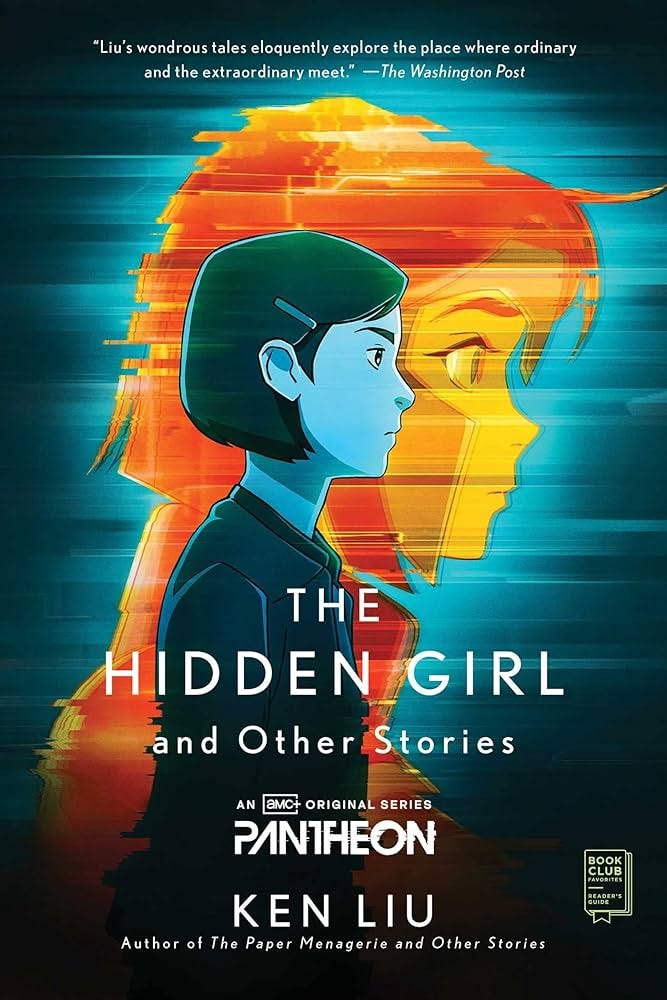
The Hidden Girl and Other Stories (Ken Liu, 2020). The Hidden Girl is nominally a sci-fi anthology. And it does feature advanced technologies, aliens, digital minds. But sci-fi worlds are just a canvas for Liu’s real interest – history, family, and continuity with the past.
This theme jumps out from every page. An alien technology traces the path of an antique through hundreds of years of family history. A Japanese-American physicist uses her family’s ancestral ability to talk to ghosts to help the US win World War II. A story about digital minds ends up being about the difficulty of parent-child relationships (so does another story about digital minds… and then another…)
I think a lot of readers would love this as a fresh approach to the “immigrant story”. If you like that kind of story, you will love The Hidden Girl. Unfortunately, I’m a member of the rootless cosmopolitan class. You know the type. We form enclaves with other rootless cosmopolitans in memoryless global cities, all of which are more familiar to us than our parents’ hometowns. The past, like all countries, is foreign to us. We are the slingers of New Yorker fiction and Atlantic cultural analysis. To cope, some of us cook up new mongrel identities, while others deploy ironic detachment. Above all, we only make sense in the present. So to read stories whose animating concern is continuity with a sacred past – that was a needle in my eye. Even though The Hidden Girl is objectively a good book, it was not for me.
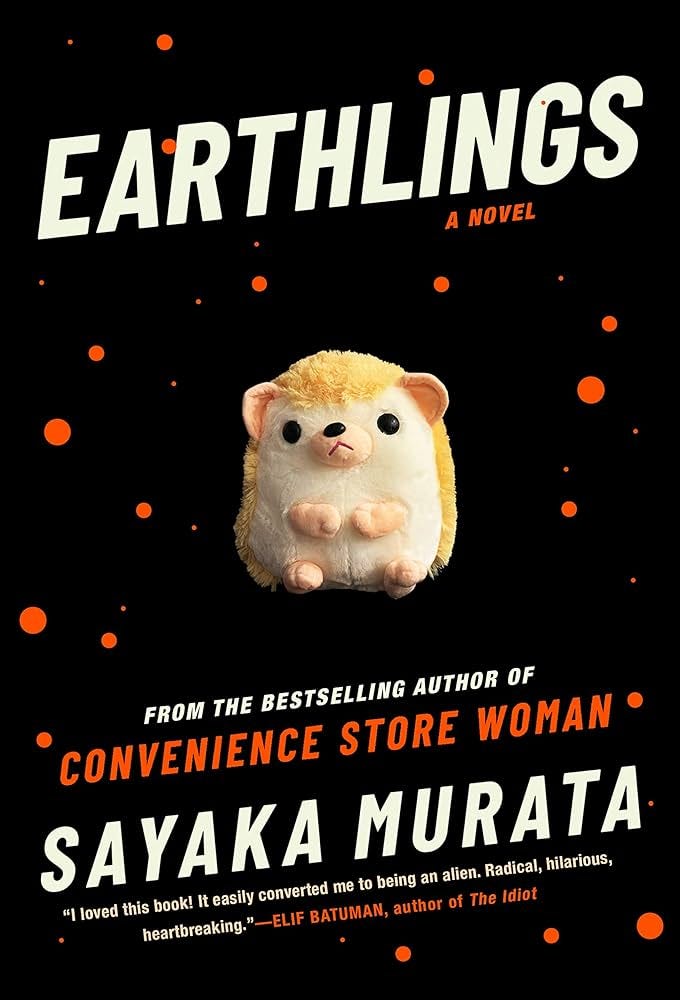
Earthlings (Sayaka Murata, 2018). The protagonist of this book is a neglected child. Her family hurls constant abuse at her, her teacher pervs on her, and she has no friends. Her only friend is her cousin who she sees once a year, where they talk about being aliens from another planet and promise to get married to each other. Joyous life indeed.
The second half of this book flashes forward to the protagonist’s adult life, where she has married a man who is somehow even stranger than her. This was where all the trauma porn buildup could have paid off. And there were some really unsettling moments that I loved. But it didn’t go anywhere. My eyes glazed over reading “our wombs and testes belong to the factory” for the hundredth time. The protagonist’s cousin could have been such an interesting character, as someone whose childhood was miserable like hers, but who grows up to be much more well-adjusted than her. Instead, he folds like wet paper. I can’t recommend this book.
Demons (Fyodor Dostoyevsky, 1872; translated by Richard Pevear and Larissa Volokhonsky). I’ve been in Shortstoryland for a long time, and I’ve been itching to find my way back to Seriousnovelistan. An unremarkable microsite essay about the AI race introduced me to Demons, so I saw my chance.
In Demons, we are introduced to a provincial genteel society and its colorful characters, who hold readings and intellectual salons, oohing and aahing over the latest ideas in vogue. Its characters are practically parodies, which could trick you into thinking it is a comedy book. But their oafishness is simply a setup, as sinister individuals gather in the province, gaining influence and laying the foundations for a violent plan. The book is one enormous piece of kindling, and its tension comes from wondering if and when everything is going to catch fire.
Dostoyevsky writes characters who are stand-ins for particular ideologies. But because he fabricates them with such richness, he convinces you that the particular ideologies are actually just masks for an underlying personality type. That is how a book about political revolution ends up mainly being about the disturbed and broken psyches behind it.
I wanted this book to transform me. Dostoyevsky was a genius, etc, so surely I should have revelations about my own life by seeing through his eyes. But if Demons is about anything, it is the danger of externalizing your desire for self-transformation. So it goes. I searched for epiphany, but I just found an excellent book.
If you want to know whether you will enjoy Demons, read this excellent review. It’s spoiler-free, because it happens to not be about Demons at all. But it is still the best articulation of what you’ll find in Dostoyevsky’s pages.
Movies
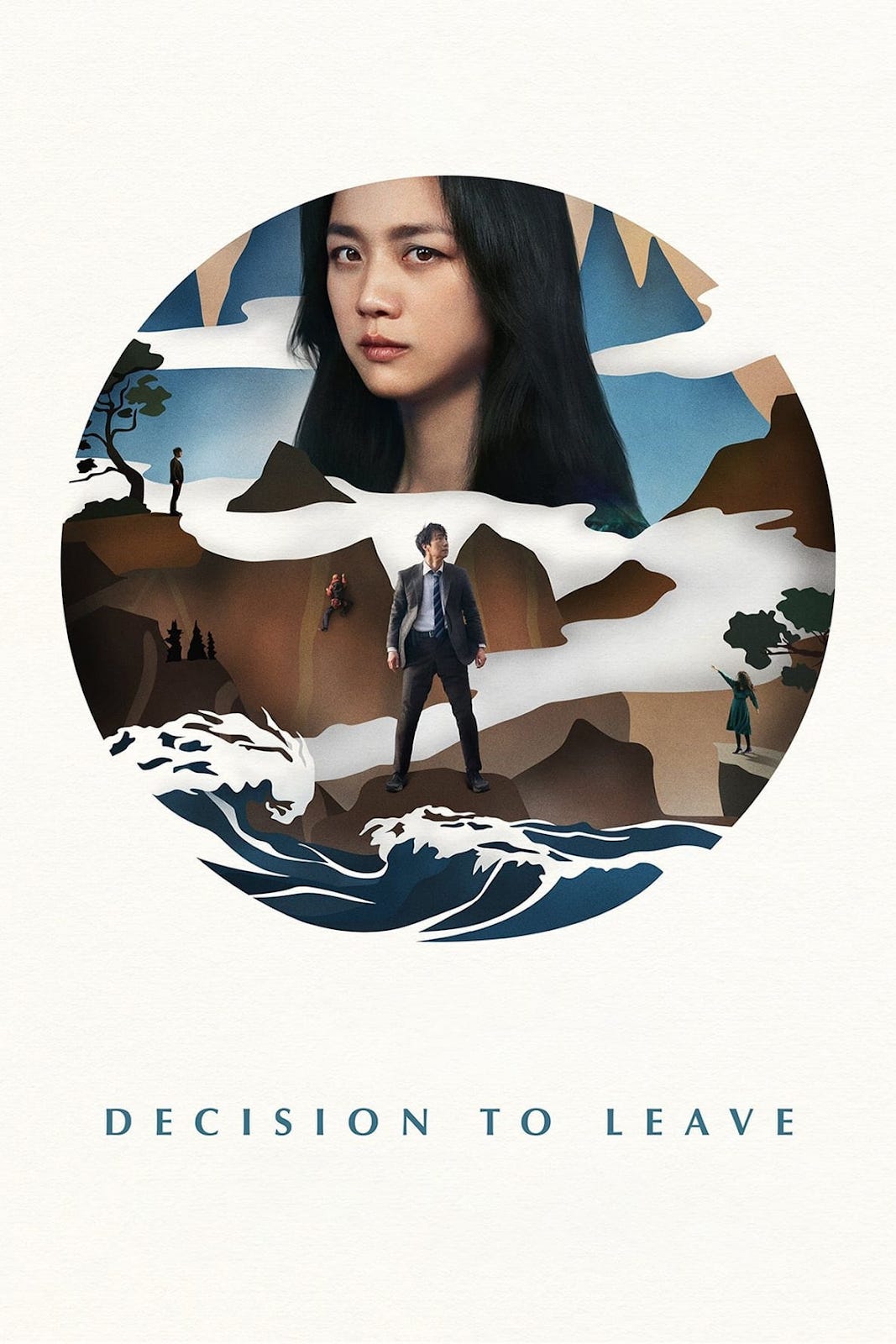
Decision to Leave (Park Chan-wook, 2022). Technically I watched Decision to Leave at the end of January, but I loved it too much to skip it.1 A detective investigates the death of a man who fell off a mountain, growing convinced that the victim was murdered by his mysterious widow. While investigating her, he falls in love with her, while his own marriage flounders. From there, things fall apart.
My critical brain was pin-drop silent during this movie. I was simply zoned in on the most twisted and compelling love story I’ve seen in years. But I’m aware that if I want you to watch this movie, I should collect my thoughts and say something more descriptive. The detective-suspect relationship is thrilling because it inches delicately through whether she is a murderer, and whether he cares, a minefield that both of them crawl through at a deliciously slow pace. The chemistry between Park Hae-il and Tang Wei is outrageous.
If you loved No Other Choice or any other Park Chan-wook film, let the momentum carry you deeper. Go watch Decision to Leave.
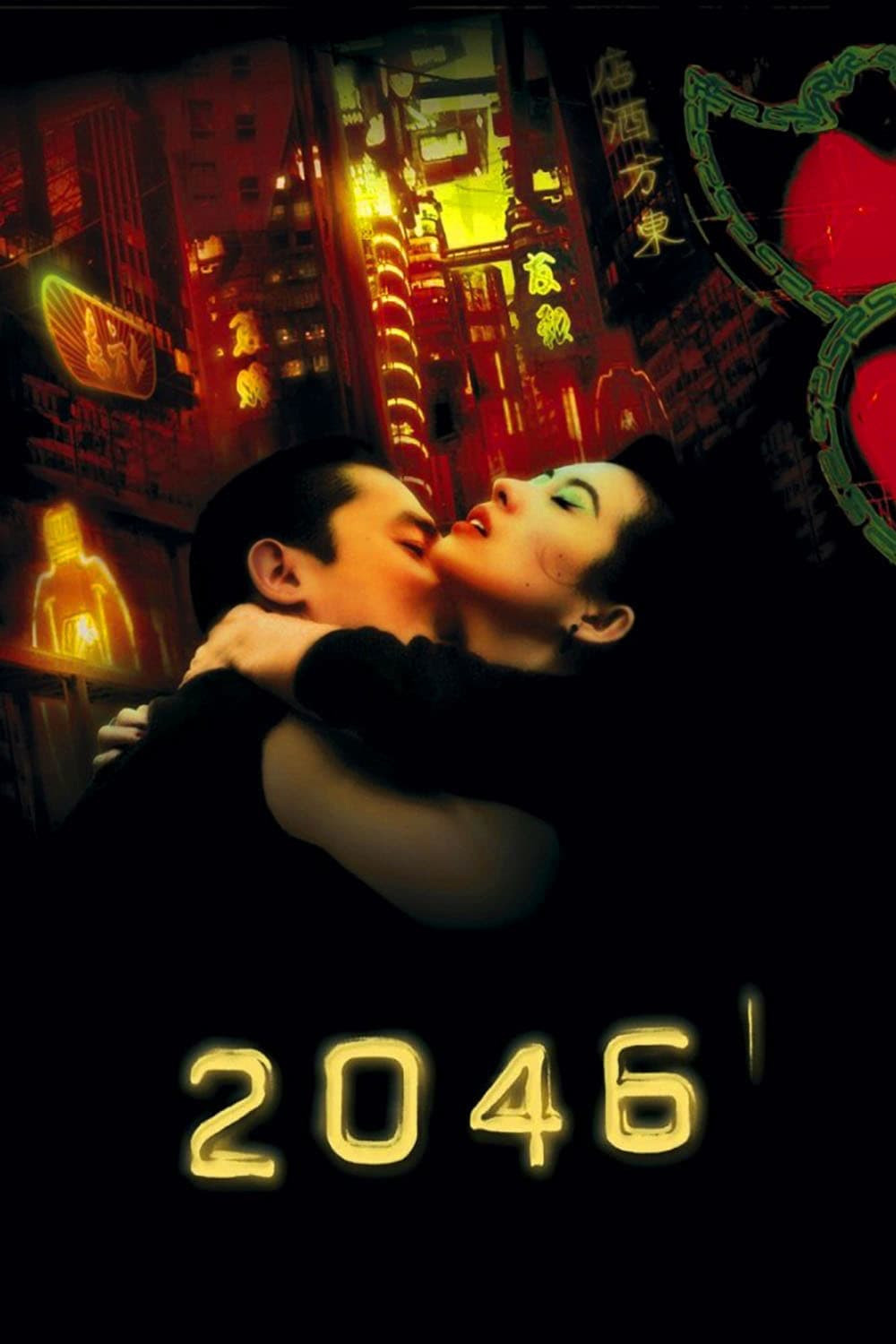
2046 (Wong Kar-Wai, 2004). I see why this movie lives in the shadow of In the Mood for Love, to which it is a sequel. It’s a huge mess. It has too many plotlines that are chopped up and scattered across the runtime, the sci-fi elements are bizarre, and of course it suffers without Maggie Cheung’s magic.
But 2046 is still special. While In the Mood for Love is a love story between two people, 2046 is relentlessly lonely. It shows a man recovering from heartbreak, and asks, what if he just never recovered? Tony Leung’s new playboy persona is caring and open, but he can’t reciprocate the love that other people give him. It’s not that he is hiding from his own feelings. He could string them along, using them as substitutes in a half-hearted attempt to get over his own heartbreak. But he prefers to tell women to their face that he’s not in the mood for love.
His missing heart is not with Maggie Cheung, as you might assume. No, his heart is in a place called 2046. On one level, 2046 is the number of the hotel room he shared with Maggie Cheung. On another level, 2046 is a place where nothing ever changes. Nobody has ever come back from 2046. He writes a story in which the protagonist boards a train back from 2046 to reality. But the train journey never ends. He reenacts failed relationships with the android train attendants, hoping for something to change, but of course it doesn’t.
He declines to treat the many women in his life as substitutes for the one woman who is not in his life. He is wise enough to know that won’t make him whole. But this wisdom is worth nothing, because he can’t find what will make him whole. He suffers enlightened defeat after enlightened defeat, and ends up the most enlightened broken man under the sun.
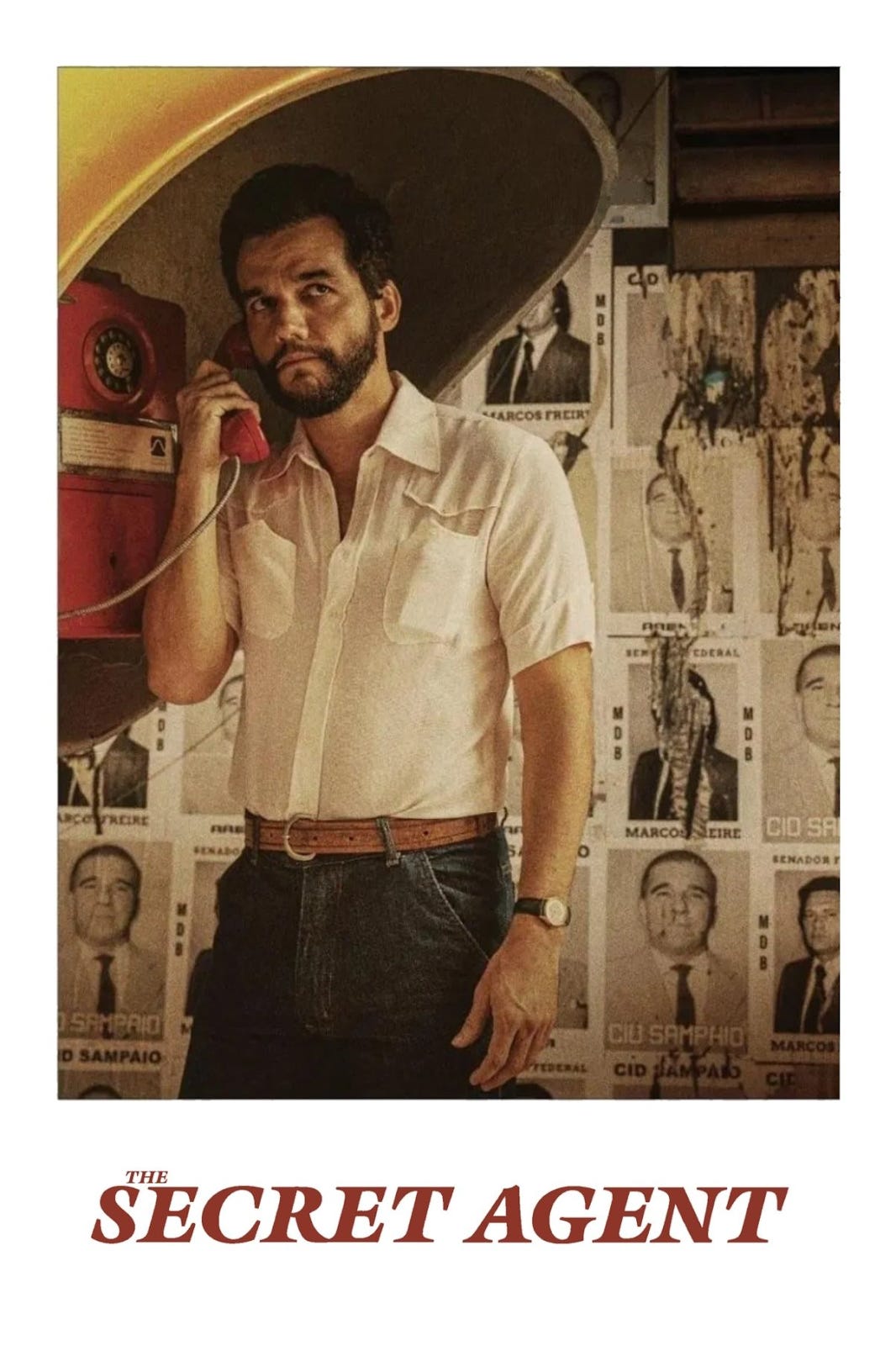
The Secret Agent (Kleber Mendonca Filho, 2025). This was a good movie, probably. I was short on sleep when I watched it. Maybe that’s why I got cranky at its length, at the anti-climactic ending, at the fact that there is no secret agent in a movie called The Secret Agent. Yes, that’s technically a spoiler, but it’s one you’re better off knowing before you go in with false expectations of what kind of movie you’re watching. I suspect that if I watched it with a more generous and open mind, I would have enjoyed it. The relationships formed throughout the movie are sweet and compelling, the climactic confrontation is thrilling, and the frame story of two students in 2025 revisiting this story through archival tapes is pretty cool.
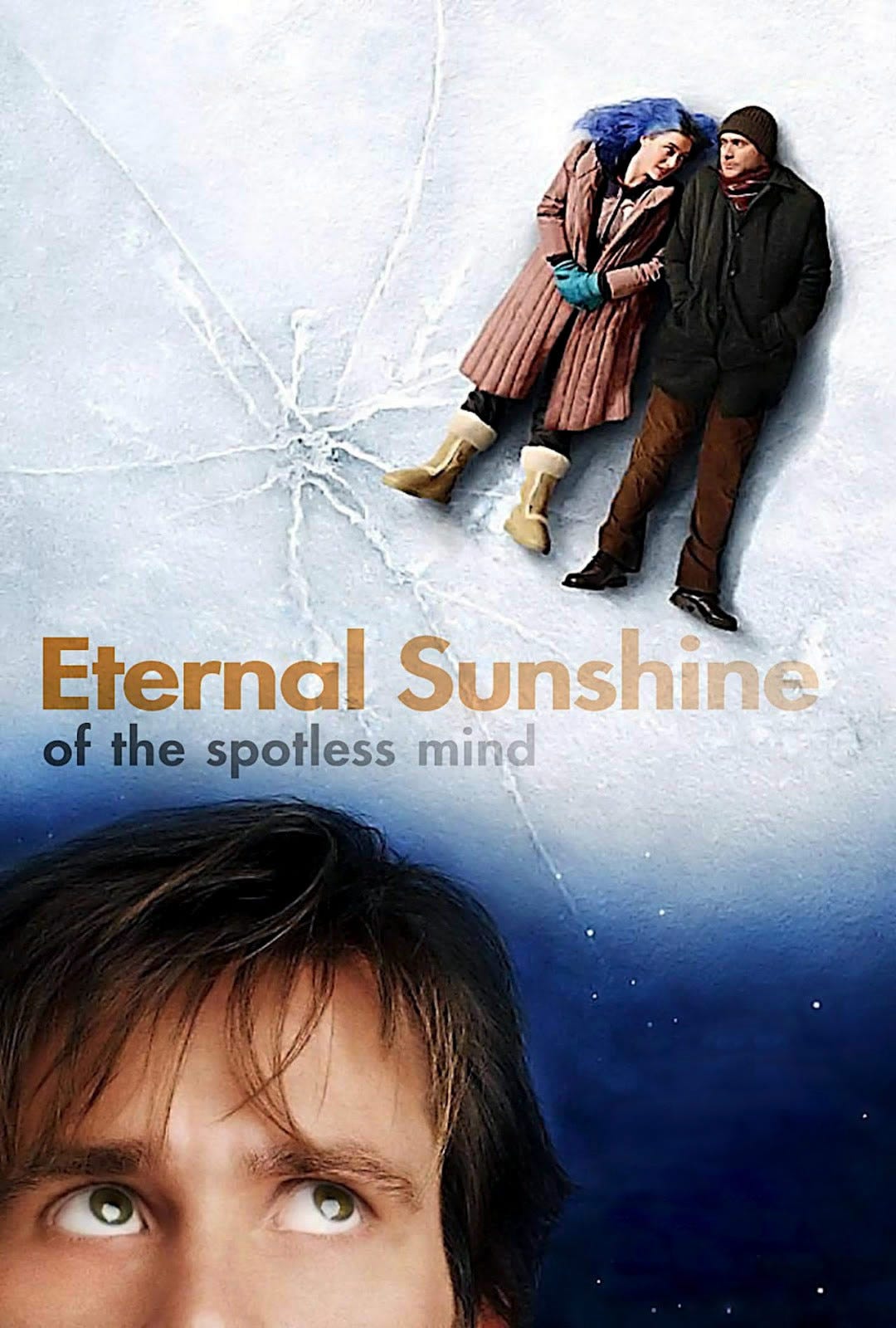
Eternal Sunshine of the Spotless Mind (Michel Gondry, 2004). A core experience of being on 2010s Tumblr was seeing every other crazy person post the clip of Clementine saying “Too many guys think I’m a concept or I’m going to complete them, but I’m just a fucked up girl” and declaring that this movie DESTROYED the manic pixie dream girl trope with FACTS and LOGIC. By affiliation, I nursed some scorn for this movie, and put off watching it for a long time. How wrong I was! This movie deserves all its praises and more.
I have a bad tendency to write off flawed characters and flawed relationships. “He sucks, she sucks, so this relationship is pointless.” Rayne Fisher-Quann:
One of the most remarkable pleasures that love has to offer, in fact, is the feeling of meeting someone who is scarred and beat-up and bruised, too emotional or not emotional enough or oscillating wildly between the two, and offering to love them enough to help them get better (and, of course, to have them do the same to you). To grow beside a friend or lover, knowing that you will poke and prod at each other as you take shape but unafraid of the resulting scar tissue — this is the good stuff.
I didn’t like Joel or Clementine at all. But despite that, I was rooting for them. To see them listening to an audiotape of the worst things they ever said about each other, and still choosing each other – this is the good stuff indeed.
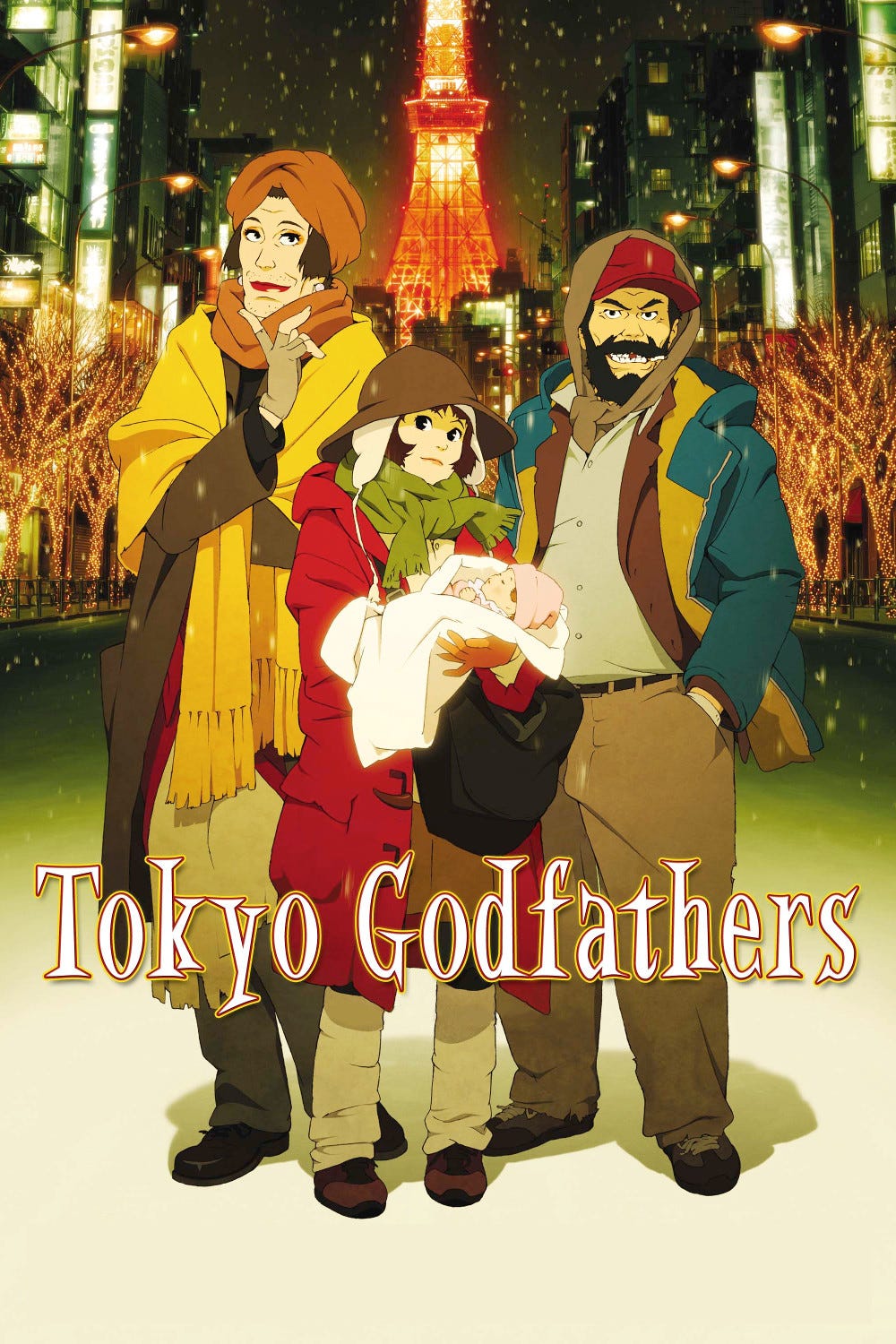
Tokyo Godfathers (Satoshi Kon, 2003). I have a bad habit of comparing everything by Satoshi Kon unfavorably to Perfect Blue, my favorite movie of all time. This comparison clearly sabotages my enjoyment of his other excellent work. But Tokyo Godfathers broke that spell, because it is so different from Perfect Blue, and yet so undeniable on its own terms.
The protagonists are an unlikely chosen family: an alcoholic bum, a trans woman and a teenage runaway, all living on the streets of Tokyo. On Christmas Eve, they find an abandoned baby on the street. Each of them is stung by their own tangled history with family, so finding this baby gives them a chance for catharsis if they can return it to its parents. Their adventure takes them through a gang war, a drag club, and a police chase. It is insane, balls-to-the-wall fun.
Towards the end, the hijinks got a bit too wacky for me. But this movie should be an iconic Christmas movie. Our protagonists are such a great dysfunctional family, their love is heartwarming, and they are hilarious on top of that.
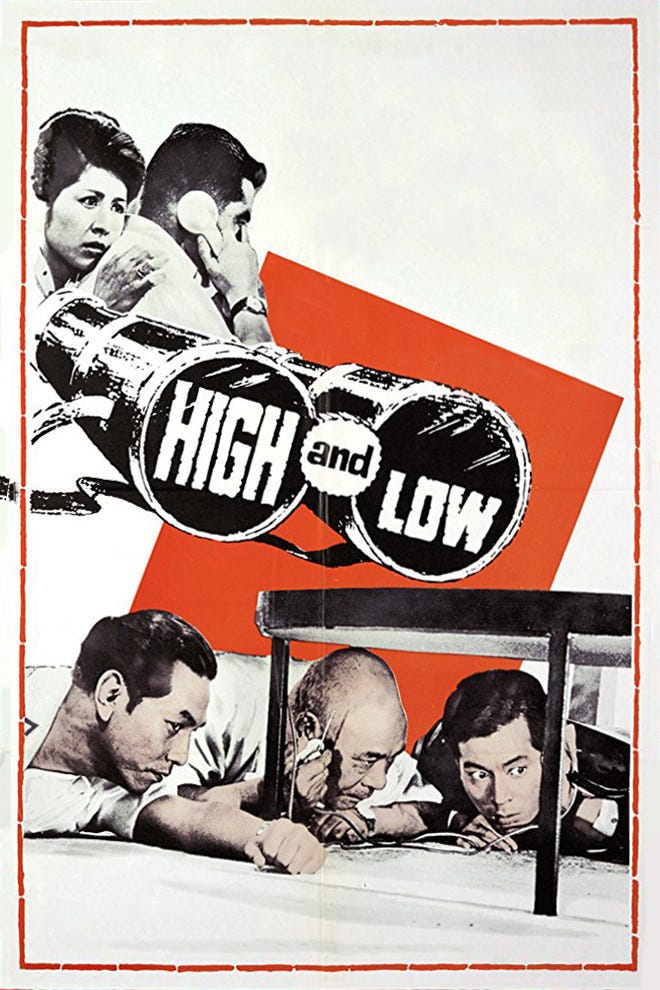
High and Low (Akira Kurosawa, 1963). Some movies can be charitably described as “revolutionary”. They earned their place in the film canon by being groundbreaking for their time, and influencing everyone who came afterwards. But they’ve been outdone by the passage of time. What was new and fresh is now tame and cliche.
Well, High and Low is not “revolutionary”. High and Low is a damn good movie, and it remains damn good today. Even if you don’t like black-and-white movies, even if you prefer modern movie aesthetics, I bet that High and Low will be a more thrilling watch than whatever modern suspense movie is on your backlog.
The movie has two halves. In the first half, an ambitious executive has to decide whether to pay a ransom for his valet’s son, who was kidnapped by mistake instead of the executive’s own son. He’s gone heavily into debt in order to execute a corporate takeover; if he pays the ransom, he can’t make his move and will lose all of his property. But if he doesn’t, a child might die. The tension ratchets up as he makes his decision. In the second half, without giving away how the ransom goes down, the police try to find the kidnapper. The tension shifts from moral dilemma to police procedural. Exposition-dumping mixes with extended sequences where the police follow the kidnapper through a crackhouse or a nightclub. In the end, the kidnapper and the executive come face-to-face for a final confrontation. This is absolute cinema.

My Blueberry Nights (Wong Kar-Wai, 2007). I have mixed feelings about this movie. To elicit the electrifying performances that define his best movies, Wong Kar-Wai supposedly tells his actors, “jump, and I will catch you.” Well, either the cast of My Blueberry Nights did not jump, or he did not catch them. It’s a struggle to stay invested when the leading couple have so little chemistry, when the relationships fostered on the cross-America road trip are so shallow. I don’t think I could recommend this movie.
But even though I can’t recommend it, I was very fond of this movie. My Blueberry Nights is Wong’s first English movie, his first movie set in America. And it is clear to me how much of Wong’s America is America from the movies. We have a Brooklyn cafe, we have a Memphis diner, we have a Vegas casino, we have a road trip across the country. The femme fatale con artist from Vegas speaks with a Southern drawl, for no reason at all. If those aren’t enough American tropes crammed into the pie for you, the main character’s dream is to buy a car. It’s so damn movie that I could smell the butter through the screen.
Like Wong, I grew up on American TV shows and movies. So the America of high school drama and suburban family life felt magical. Of course, once I moved here, it all faded into background noise and bland highways. But as the absurdity of Wong’s America played out on screen, I was enraptured by the memory of how I used to see America. We come to this place for magic, after all, and I have to credit My Blueberry Nights for that little spark.

Kokuho (Sang-il Lee, 2025). I sometimes say I don’t believe in soulmates. I cop to being reflexively contrarian, but more importantly, I nurse a different idea of a soulmate. Not someone you fall deeply in love with, or who knows you intimately. I think your soulmate is someone whose destiny is intertwined with yours, who saturates so many signifiers in your mind that every shadow on the wall looks like them. They are the co-creator and recipient of your love, your fears, your almost sexual hatred. Their victory is your suffering. Their love is your poison. But their burial will be your burial.
Kokuho is a movie about two soulmates. One of them is the orphaned son of a yakuza boss, adopted by a renowned kabuki actor who sees greatness in him. The other is that actor’s biological son, groomed to be his father’s heir. These two go to school together, train together, act together. But the journey to greatness is isolating, especially when your greatest skill is pretending to be someone else. That journey severs them from each other, but it severs them from other people even more. They are unified in their isolation and their pain.
Loneliness comes first in Kokuho, and loneliness comes last too. But in between, there comes the possibility for your soul to find its mate, and perform the story it was born to perform.
Miscellaneous
I watched M Butterfly, performed at the San Francisco Playhouse. A French diplomat falls in love with a Chinese opera singer, who turns out to be a CCP spy. On its own, this is an interesting premise. But nobody in the audience bought their tickets because of this premise. All of us came because we knew the explosive secret hidden within this story, and the real case it was based on. If you don’t know that secret, do not look it up. I promise you that your experience will be special.
If you don’t know what brought everyone else to the auditorium, why should you watch M Butterfly? It could be to see the worldview behind orientalism and yellow fever get skewered and barbecued. And yeah, the psychosexual exploration of a white man in China is gripping. But that’s not what compelled me most.
When we don’t know what we want, we substitute our individuality with social images of what we should want. These are “mimetic desires”, but I prefer to call them sexy-nurse desires. After all, nurses are sexy as a cultural symbol, as a porn category and a Halloween costume. Attraction to nurses is a desire that comes from the milieu. It is the opposite of desire born of your own particularity.
M Butterfly is a story about a man who cultivates a sexy-nurse desire for twenty years. But when the bombshell drops, and he has to choose between his sexy-nurse desire and his real desire, his identity collapses. He looks in the mirror and sees only the image of what he is supposed to want.
If that sounds compelling to you, shows run till March 14 – go get your ticket.
It also claimed a spot from Park Chan-wook’s Joint Security Area, which I did watch in February, but which was so boring I had no desire to talk about it.
Someone was just telling me about Ken Liu today — I’ll take it as a sign to check it out! Though Earthlings was quite grotesque I actually “liked” it (if one can use that word about this book) quite a lot. It stands out among Murata’s other books about repressed women in Japanese society.