
I was going to open this roundup with something like “this month was my most intense in a while, but I somehow also watched a lot of movies and read a lot of books”. But I opened both of my previous roundups that way. Moreover, all three months it has been true! As my life becomes more chaotic, I seek the intense escapism of media even more.
Books
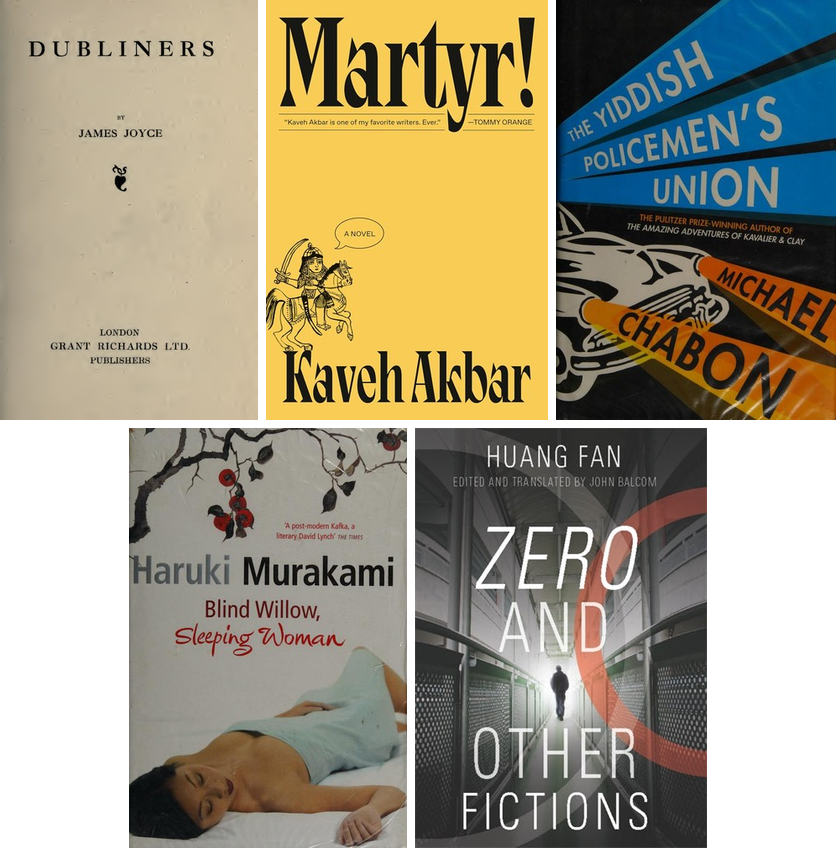
Dubliners (James Joyce, 1914).
I read this for a book club, that I posted about a while ago – thank you to everyone who showed up!
Dubliners is a collection of fifteen stories set in Dublin at the turn of the 20th century, covering the lives of Dubliners from childhood through old age. It is a strange book. My main fear going into the book was Joyce’s reputation for difficulty – I imagined the book would be full of dense syntax and obscure allusions. That wasn’t true – Dubliners is clear and readable. But that readability doesn’t prevent you from getting to the end of a story and being confused, because it’s rarely clear what actually happened in each story. So much is implied and never spoken. Much of our discussion revolved around pinpointing what actually went down with each character and what we are supposed to take away from that.
I enjoyed the stories overall, and some of them were really vivid, but I found them intolerably pessimistic. Of the fifteen stories, I counted ten with unambiguously tragic endings, one with a reasonably graceful ending, and four that were ambiguous. James Joyce endowed his characters with such rich lives, but he was determined to refuse them any grace. I can’t forgive him for that.
Martyr (Kaveh Akbar, 2024).
A recovering alcoholic queer Iranian poet, unsure what to do with his life, decides the way to find meaning is to understand martyrs – people whose death is meaningful because they are struggling against something. He learns of an Iranian artist making an art exhibit out of her impending death from cancer, and flies to New York to talk to her. From there, shit happens.
I read this book for another book club, having never heard of it before. But whenever I brought it up to people, the overwhelming response was either “Oh, I loved it” or “Oh, I’ve been meaning to read it”. I have no idea how it got so popular, but it deserves that popularity.
The protagonist of Martyr is not very likeable, especially at the start, and for much of the book it reads like the kind of “my personal issues are all caused by historical injustices” story that I’m not very sympathetic to. But in the last ten chapters, it takes some very sharp turns that recontextualize everything before that. I can’t say much more than that without thematic spoilers, but I can say it was a much more nuanced story than it seemed at first.
The Yiddish Policemen’s Union (Michael Chabon, 2007).
I’ve been pining for Disco Elysium enough that I just started googling “books like disco elysium”. This is how I found The Yiddish Policemen’s Union, a murder mystery set in an alternate history where Israel collapsed immediately after World War II and the U.S. set up a temporary Jewish reservation in Alaska. 60 years into this arrangement, just before the land reverts to U.S. control again, a heroin junkie is murdered in a shitbag motel. In the chaos of the transition, the only person who cares to figure out what happened is a dysfunctional alcoholic detective, still madly in love with his ex-wife (who is also his supervisor), and a fellow resident of said shitbag motel. Despite the chaos of the transition, despite his impending statelessness, and despite facing immense pressure to drop the case, our protagonist pursues the case all the way to the top, hoping to find his own salvation along the way.
As you might be able to tell from the outline, the book verges on cheesy with how noir it is. You could imagine a husky narrator saying some shit like “the streets echoed with the memory of a gunshot”. But despite the atmosphere of decay all around, the book is suffused with grace. Every street, every corner, and every person in this doomed city is beautiful. It has a compelling mystery, sharp emotional stakes, and a poignant ending.
Blind Willow, Sleeping Woman (Haruki Murakami, 2006).
I struggled through this collection for six months and finally finished it in April. It’s a collection with far too many stories for me to say anything cohesive: some are great, most are unmemorable. If I had to recommend one, I’d point to “Where I’m Likely to Find It,” in which a private detective searches for a woman’s husband, who disappeared in the stairwell between the 24th and 26th floors of an apartment building. But the bottom line is, even if you like Murakami, you can skip this collection.
Zero and Other Stories (Huang Fan, 2011).
In most universes I never encounter this book. It required me to go to Taiwan, to decide to read Taiwanese authors for my trip, to borrow a different Taiwanese book from UC Berkeley’s library, and then pull a random volume off the shelf beside the Li Ang book – a book with no jacket and no cover. That book was Zero and Other Stories.
The collection features three short stories and one novella. What’s unusual is how different the style of each story is. The first is a political satire about a former activist in military-era Taiwan who learns that the leader of their anti-government group was a grifter who only wanted power. The second is an absurdist story about a man who starts three families in three different countries, and ends with all three wives making backroom deals without him. The third is surrealist metafiction with a writer recalling when he and his teenage friends tried to measure the width of a ditch. That one didn’t fully land for me. But this is not the range I expected from one author.
The title novella, Zero, takes this range even further. It’s a dystopian story about an engineer working for a totalitarian world government, who discovers its true nature and tries to do something about it. I find dystopian fiction boring at the best of times, let alone when it copies notes extensively from 1984, so I didn’t expect to enjoy this.
But Zero turned its premise into something unexpected. Perhaps because Huang Fan actually lived under an authoritarian regime (Zero was published in 1981, before Taiwan’s transition to democracy), his interest is not simply in declaring that authoritarianism is bad. Rather, I think he wanted to warn other intellectuals about the temptation of grand narratives when you’re living inside a system you don’t understand. The government is bad, but that doesn’t mean the opposition can be trusted either. Truth is unknowable in the fog of war. And if you knew it, what would you do with it? Would you change the world, or protect your ego built on false beliefs?
Unfortunately this book is Huang Fan’s only translated work, so I’ll probably never read another story by him. But I’m so glad I found Zero.
Movies
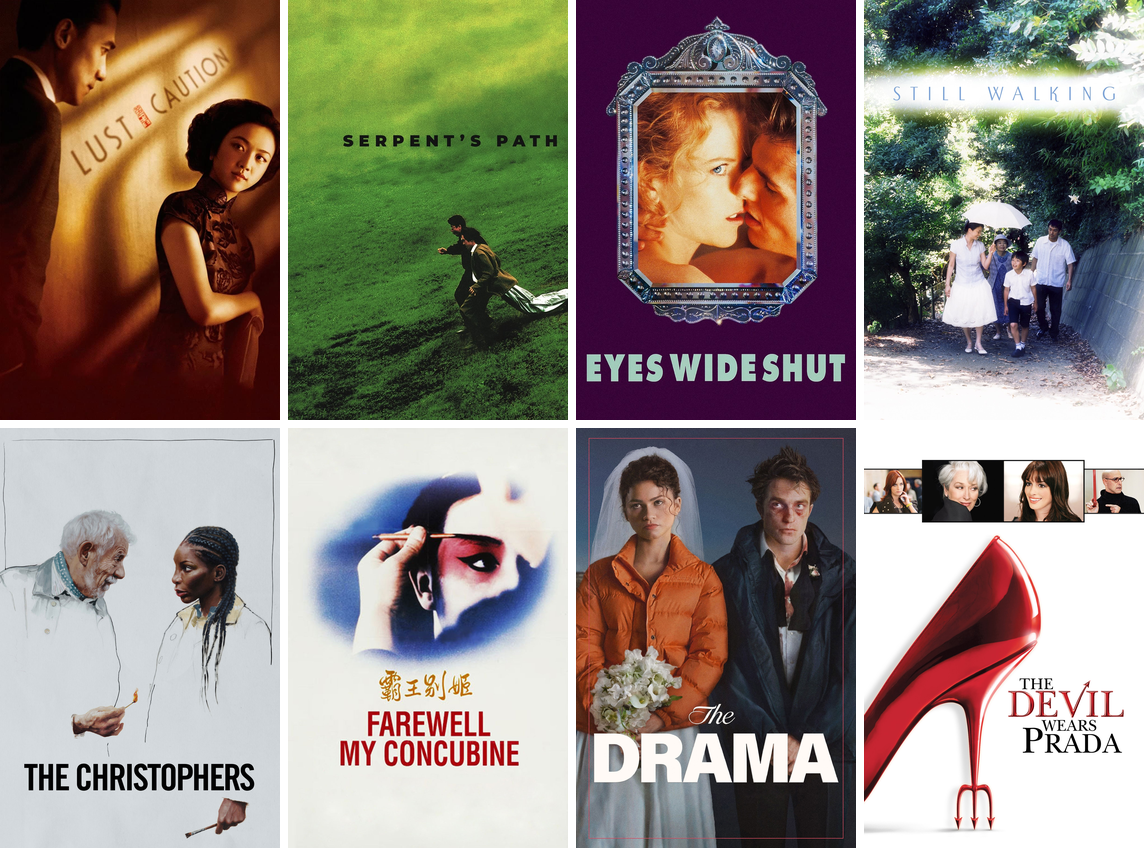
Lust, Caution (Ang Lee, 2007).
Patriotic theater kids in occupied China try to use a honeypot scheme to assassinate the secret police chief of the Japanese puppet government. If this premise does not one-shot you, know also that it stars Tony Leung and Tang Wei (whose femme fatale in Decision to Leave entranced me).
I loved this movie, mainly because I love actors acting like actors. Tang Wei plays a character who is herself an actor, whose behavior and feelings straddle the line between genius manipulation and losing herself. I wasn’t so bought into her chemistry with Tony Leung, but they had their moments. The ending caused pandemonium among the friends I watched it with, but it felt perfect to me.
Serpent’s Path (Kiyoshi Kurosawa, 1998).
This was the first Kiyoshi Kurosawa film I’ve enjoyed in a long time. A recurring theme in his movies is that we are only separated from our monster-selves by a thin veil that can be undone at any time. But in most of his movies, that idea is muddled by supernatural hijinks and cheap scares.
Not in Serpent’s Path, where a man seeks revenge for the brutal murder of his daughter, guided by an unnervingly normal math teacher with unknown motives. Sho Aikawa carries the movie in the latter role, never raising his voice or changing his facial expression no matter how deep down the serpent’s path they go. As each possible culprit they kidnap points the finger at someone else, the tension escalates, and the organization they’re hunting starts to hunt them back. I wasn’t totally satisfied with the ending, but this was still a great movie.
Eyes Wide Shut (Stanley Kubrick, 1999).
This movie is boring. It is strange to say that about a movie depicting a cabal of powerful, sexually-degenerate people who will go to extreme lengths to cover up their crimes – who could imagine that happening? – but it’s true. The secret society that makes up the core of the movie’s tension never amounts to anything. It’s a shadow on the wall, not a real antagonistic force that takes any action. More interesting is the psychological turmoil in Tom Cruise’s character as he confronts his own potential for sexual degeneracy, but this too never amounts to anything.
Still Walking (Hirokazu Koreeda, 2008).
I have a theory that some authors/directors fundamentally believe in salvation (e.g. Anton Chekhov, Jhumpa Lahiri, Akira Kurosawa), while others fundamentally don’t (e.g. Alice Munro, James Joyce, Bong Joon-ho). It’s a gloss, but I basically believe in it.
But I don’t know what Hirokazu Koreeda believes in, because Still Walking is so painful and yet so full of grace. A family gathers every year on the anniversary of a certain event, and that gathering lays bare the tensions of their relationships. Of course, family is never just a source of salvation, or a source of damnation. It’s a bed of twisted vines and tender thorns that we grow up in, and leave a part of ourselves in forever. Koreeda depicts that in all its gore and glory.
The Christophers (Steven Soderbergh, 2025).
This movie was pretty damn cool. An art restorationist is hired by the children of a dying artist to forge his final paintings, works that the artist himself has been unable to finish for years. It was full of plot twists, even though it’s not a thriller. At every point where I tried to predict where the story was going, I was wrong. The dialogue is smouldering, and the film’s central question – how do artists connect to their work, and to the people in their lives? – is one I was very happy to see explored this carefully.
Farewell My Concubine (Chen Kaige, 1993).
This movie made me very angry, which makes me sad to say, because I was so close to loving it. Two Peking opera stars with a lifelong homoerotic bond grow apart, as one of them gets married to a woman, and the onslaught of 20th century Chinese history threatens to drown all three of them. The three main characters were all deeply realized people, whose pain I felt and who I wanted to see happy. The movie was so good at showing the whirlpool of history pulling them back into hell, over and over. But towards the end, the pain felt gratuitous, tragedy for the sake of tragedy. The last segment of the movie is so jumpy, with events so disconnected from each other, that I kept wondering if I had missed something.
The Drama (Kristoffer Borgli, 2026).
This movie was a fun train-wreck. I can’t summarize it without spoilers, and indeed the extensive marketing for this movie is entirely silent about its plot – because it relies on a shocking reveal and a resulting dilemma. My main issue is that the dilemma at the center of the movie just… doesn’t seem like that much of a dilemma to me? Maybe this is a failure of imagination on my part, but the conflict seemed unnecessary, which made me feel less engaged. But the escalation of this unnecessary drama was still batshit insane and I liked seeing it unfold.
The Devil Wears Prada (David Frankel, 2006).
What a fun movie! I don’t care much about fashion, the relationships were superficial, and the plot was mega-predictable. But I just had so much fun. Every character was gorgeous, Emily Blunt and Stanley Tucci were particularly endearing personalities, and I had a good time watching with my friends.
Other
Julia is a short story in which a sentient spaceship tracks an anomaly through the universe. It is as unsettling as it sounds, and the writing is psychedelic. I had a mild fever dream about this story the night after I read it.
That’s it for April! I hope you enjoyed. If you read any of these books or watched any of these movies, let me know your thoughts :)
Coincidentally I also read Martyr for my book club in April. I didn't like it quite as much as you did, but thought it was fine --- too many things were happening at the end for me to really feel invested in any of them.