
You know what’s in this summer? No? Darn, I was hoping to find someone who does. In the meantime, I keep reading books and watching movies and sometimes things change and sometimes they stay the same. Here is everything I read and watched in May!
Books
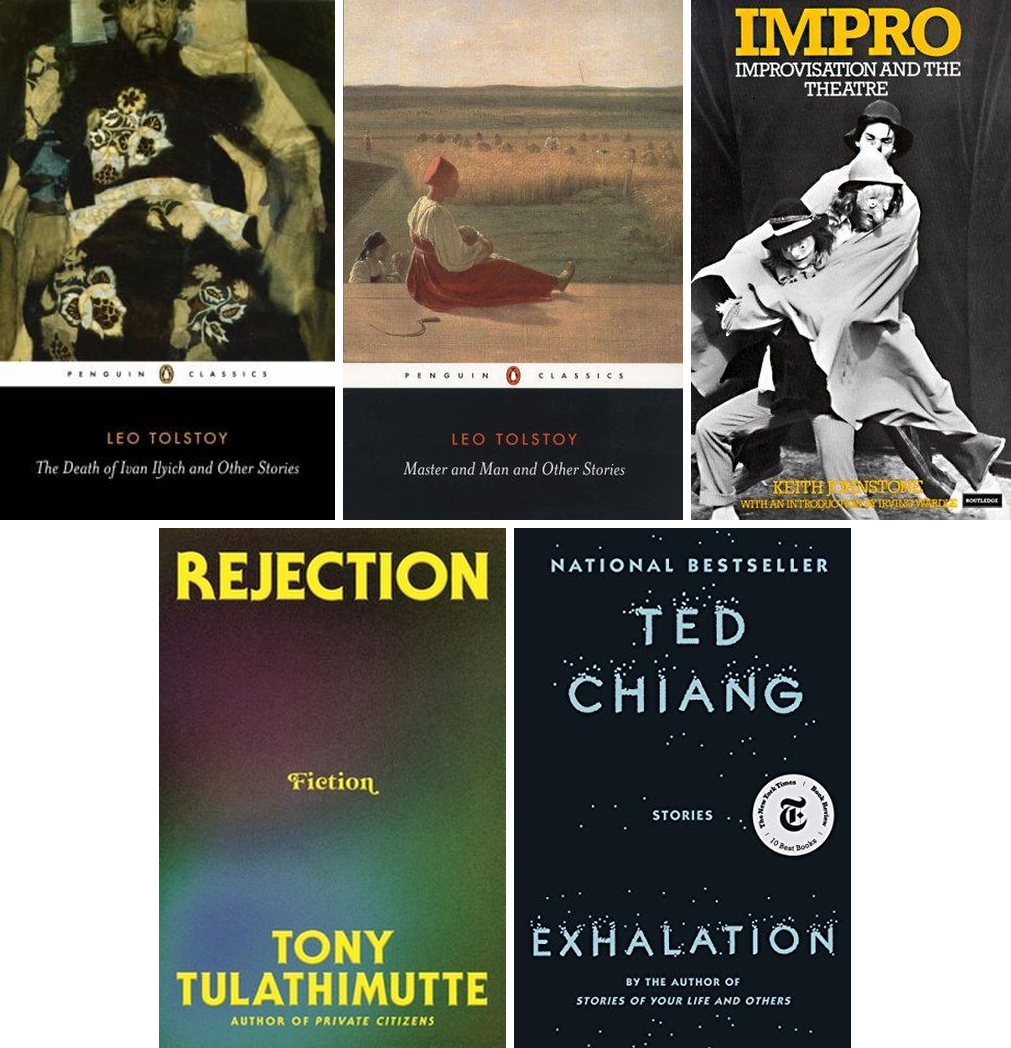
The Death of Ivan Ilyich and Other Stories + Master and Man and Other Stories (Leo Tolstoy).
Carly Camacho describes a stunningly perceptive message she received from a Hinge match in response to an intensely personal essay she shared with him. His message showed a deep understanding of her based on her writing and a curiosity to know more about her – seemingly the best possible outcome from sharing something that personal. But she unmatched him almost immediately, because his message made her realize that she is terrified of true intimacy.
I didn’t understand her at first. I style myself a brave knower and knowee, and the idea of being known seems wonderful – the entire point of being here. But I understand how she feels when I imagine Tolstoy turning his eye towards me. I imagine him making a measured list of factual statements about my behavior, cutting through all the noise and narrative that I live by. I imagine him revealing me to be a weak and foolish man; similar to other weak and foolish men in some ways, but particular in other ways. He would render me richly and completely, grasping the way I love and laugh and hate and fight and grieve. All of my ineffable traits would become quite effable in his hands.
I fear his gaze even though I know he would forgive my inadequacies. In fact, I love other writers more than I love Tolstoy, but no writer loves me – and humanity – as much as Tolstoy did. His X-ray vision is what makes his love so striking, because it cannot be chalked up to ignorance or delusion. In Master and Man, he paints the picture of a greedy and reckless businessman whose greed and recklessness lead him to a series of bad decisions, decisions that spiral out of control. But in the most beautiful ending of any story I’ve read, he shows this man to be so much more than his worst traits, capable of surprising both himself and us.
To me, Tolstoy is the closest writer to a poet. By which I mean: I cannot square the emotional power of his gaze with the matter-of-fact descriptions that make up his stories. Father Sergius ends with a poor old woman describing her ordinary routine to a travelling old man she once knew many years ago. He doesn’t react at all; but what passes between them in that moment is an indescribable grace that brought me to tears.
This is the distinction I see between prose and poetry. Our reactions to prose are reactions to the semantic reality described by that prose. These reactions can be very strong, but they grow from the author’s power to vividly specify a certain reality with their words. In contrast, our reactions to poetry are illegible. When Mary Oliver says “you only have to let the soft animal of your body love what it loves”, it conjures not an actual body, but a certain feeling of tenderness towards the self that Oliver wants to evoke. The emotions emerge from carefully arranging fragments of images and words into certain configurations, evoking more than the semantic sum of their parts. This is what Tolstoy does better than any other writer. I won’t be free of him anytime soon.
Impro (Keith Johnstone, 1979).
Impro is a cult classic book about improvisational theater. Johnstone uses improv theater as a setting in which to offer his opinions about creativity, social hierarchy, authenticity and identity. But I think it is both overrated and underrated, because people love its weakest sections and ignore its strongest sections. This excerpt from the foreword pins down the book for me:
One of Johnstone’s plays is about an impotent old recluse, the master of a desolate castle, who has had the foresight to stock his deep-freeze with sperm. There is a power-cut and one of the sperm escapes into a goldfish bowl and then into the moat where it grows to giant size and proceeds to a whale of a life on the high seas.
That, in a nut-shell, is the Johnstone doctrine. You are not imaginatively impotent until you are dead; you are only frozen up. Switch off the no-saying intellect and welcome the unconscious as a friend: it will lead you to places you never dreamed of, and produce results more ‘original’ than anything you could achieve by aiming at originality.
That is, we are extensively schooled out of recognizing ourselves, and Johnstone’s mission is to unschool us. This is a compelling promise, and the strength of the book is that Johnstone can actually deliver on it. He offers concrete techniques to unschool yourself and be more creative, and his enduring appeal to a broader audience is that these techniques can unschool all of us, not just theater actors.
I experienced this viscerally: while reading Impro, I took part in a flash fiction contest in which I had to write a 1,000 word story in 48 hours following a prompted genre/location/key object. That weekend was particularly chaotic, and I didn’t have time to write or even brainstorm my story until 90 minutes before the deadline. With no expectations, I scribbled some free-association between the prompt terms, came up with exactly one concept worth probing, and then vomited out the story execution in 30 minutes. The result was the most interesting story I’ve written in a long time. I am not a good enough writer for this to constitute proof to you, but it is proof to me that there is immense power in Johnstone’s idea. Like his recluse, I tend to bottle up my ideas into impotence, and it took an emergency to switch off my no-saying intellect. I think this is the most important takeaway from Impro, one I hadn’t appreciated from the book’s reputation.
Because if you’ve heard of Impro, odds are you’ve heard of it because of status. In a largely self-contained essay within the book, Johnstone argues that social interactions can be viewed through the lens of status differences between the people involved, and that this is a near-complete theory of social interactions. This mental model has become influential to rationalists and other Bay Area subcultures. To me, it is clearly the weakest part of the book, and I endorse Alexander Wales’s criticism of the idea. It’s a marvellous mental model of what makes good theater, but a crappy mental model of real life. As for why it persists so strongly, that is a question I will tackle another day.
Rejection (Tony Tulathimutte, 2024).
Rejection may be universal, but as plots go, it’s second-rate—all buildup and no closure, an inherent letdown. Stories are usually defined by progress: the development of events toward their conclusions, characters toward their fates, questions toward understanding, themes toward fulfillment. But unlike marriage, murder, and war, rejection offers no obstacles to surmount, milestones to mark, rituals to observe. If a plot point is a shift in a state of affairs—the meeting of a long-lost twin, the fateful red stain on a handkerchief—rejection offers none; what was true before is true after. Nothing happens, no one is materially harmed, and the rejected party loses nothing but the cherished prospect of something they never had to begin with. If the romance plot sets up an enticing question—Will they or won’t they?—the rejection plot spoils everything upfront: they won’t. There the story stalls; but, strangely, continues. Even with no hope of requital, desire can persist, even intensify, with no guarantee of ending. The lack of happening is the tragedy.
This peach is the opening of The Rejection Plot, an essay by Tony Tulathimutte, and it hooked me enough to get his book. Rejection is a universal experience, after all, so Tulathimutte’s anthology of connected stories about people experiencing rejection promised to be interesting. But while I flew through the book and enjoyed it very much, I didn’t think it delivered on his promise to show what happens after the story stalls but strangely continues. Tulathimutte derives stories from the most extreme possible ways that people could react to rejection, leading to grotesque downward spirals that utterly ruin lives. But I found very little to grok about how 99.9% of people respond to rejection, so the book didn’t land very well with me.
In the last third of the book, Tulathimutte gets experimental with a story about the most sophisticated Internet troll in history, followed by a meta-story about Rejection itself being rejected with criticisms of the stories that came before. I liked this section much more than the straight stories that came before, and I’d gladly read more of Tulathimutte’s stories in that vein.
Exhalation (Ted Chiang, 2019).
I like Ted Chiang’s approach to sci-fi more than most. I like that he can be hopeful about technology rather than imagining only Black Mirror scenarios. I like that his stories strike a balance between pure thought experiments and human-centered narratives, with Anxiety is the Dizziness of Freedom being the best combination of the two and my favorite story in this collection. But I didn’t find the book too interesting and I don’t expect to think about it much in the future.
Movies
This month in movies was defined for me by watching virtually all of Ryusuke Hamaguchi’s filmography. I am obsessed with this man. In fact, I am so obsessed that I’ve moved all of the reviews of his movies to a standalone essay, in which I will convince you that he might be your next favorite filmmaker. In the meantime, these are the other movies I watched in May.
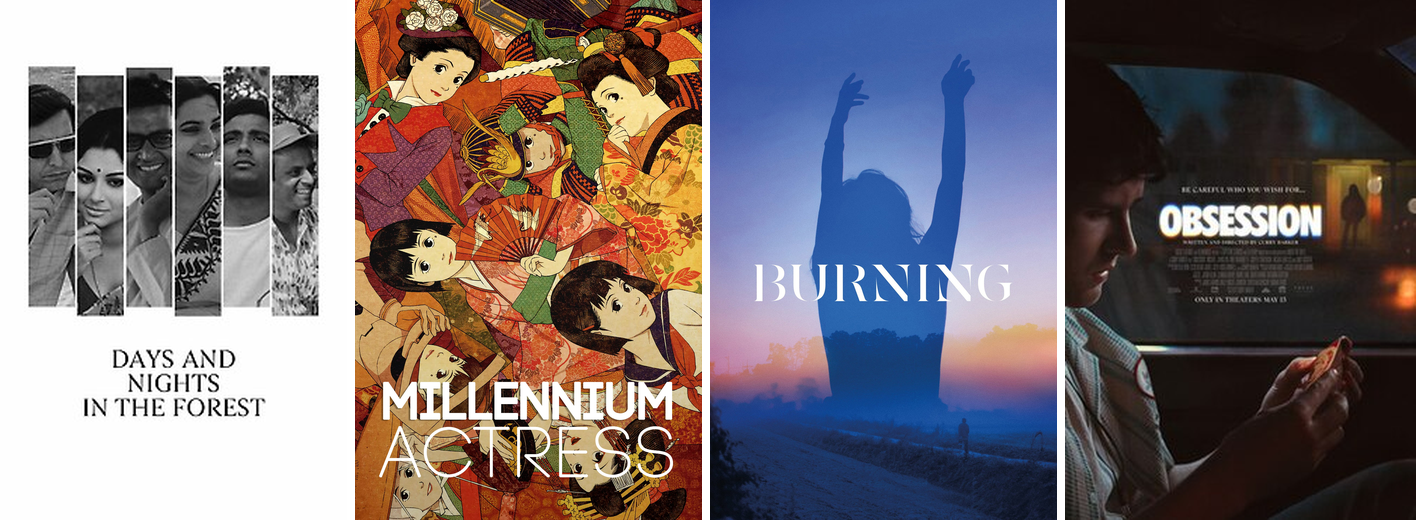
Days and Nights in the Forest (Satyajit Ray, 1970).
There is a conspicuous lack of Indian cinema in my diet, even though I know that I’m missing both exciting contemporary auteurs and iconic classic auteurs like Satyajit Ray. So I hoped for Days and Nights in the Forest to be my hook into Ray’s filmography, and into watching more Indian cinema as a whole.
This was too much pressure to put on what is an essentially luxurious film. Days and Nights in the Forest depicts the bumbling adventures of four self-important Calcutta boys taking a sojourn in rural Bihar. Many things happen, but they are all inconsequential. After all, the boys are constitutionally incapable of having consequential events. When they do brush up against the boundaries of the real, they recoil from it. With one plausible exception, the movie ends with them breezily leaving behind their misadventures, restored to normalcy and safe from the frightening possibility of personal growth.
When I first watched this movie, I didn’t love it. Its bubbly narrative didn’t appeal to me. I prefer my movies to have drama over play, heaviness over lightness. But in hindsight, its excellence is just in my blind spot.
Millennium Actress (Satoshi Kon, 2003).
The first time I watched Millennium Actress at the Roxie, I left with a little ball of light in my chest, skipping all the way home. So when I had a shitty day and needed to salvage it, I knew I had to rewatch this movie. I am glad to report that it did in fact salvage my day.
This movie… what even is this movie? We’ve got a love story, obviously. We’ve got a love story, non-obviously. We’ve got a documentary. Comedy, absolutely glorious comedy. Social commentary on the entertainment industry. Critique of military nationalism. An homage to Japanese cinema. Yes, all of these exist in the same movie, and they’re all bound together by Satoshi Kon’s signature dreaminess, his hypnotic spell to transport you to another world. Watch it and learn – that love is all you need.
Burning (Lee Chang-dong, 2018).
Burning is one of my favorite movies, but it wasn’t a very compelling rewatch. This movie needs you to be wrapped in its oppressive ambiguity, to be uncertain about where its volatile energy is going to go. But I have thought about this movie too much for any of it to catch me by surprise. It’s still an incredible mystery and the greatest depiction of male rage that I’ve seen.
Obsession (Curry Barker, 2026).
I did not have a good time watching this movie. I found the theater audio unbearably loud and there was too much shrieking for me. The theater audience I watched it with was badly behaved. I hate Discourse with a passion, which biases me against movies that provoke Discourse like this one has. So yeah, I didn’t enjoy Obsession. But objectively speaking, it is consistently scary and the way events spiral out of control towards the end is wild. It does not have surprises. If you think you’d like it based on the concept, you will like it. So if you’re interested, go for it.
That’s it for May. Stay tuned to discover the magic of Ryusuke Hamaguchi! And I’d love to hear your thoughts on these books and movies, along with recommendations :)