
Welcome back to my monthly roundups, whose frequency singlehandedly triples the amount of writing I put out into the world. If you look at my Substack history, you might justifiably suspect that this is my primary blog, and my primary blog is actually my secondary blog. And it is true that I have found art to be more fun to write about than economics…
Of course, now that I am employed (!!), I’ve got some exciting pieces queued up on the main blog. But employment didn’t stop me from the numerous books and movies of June, ~all of which were bangers.
Books
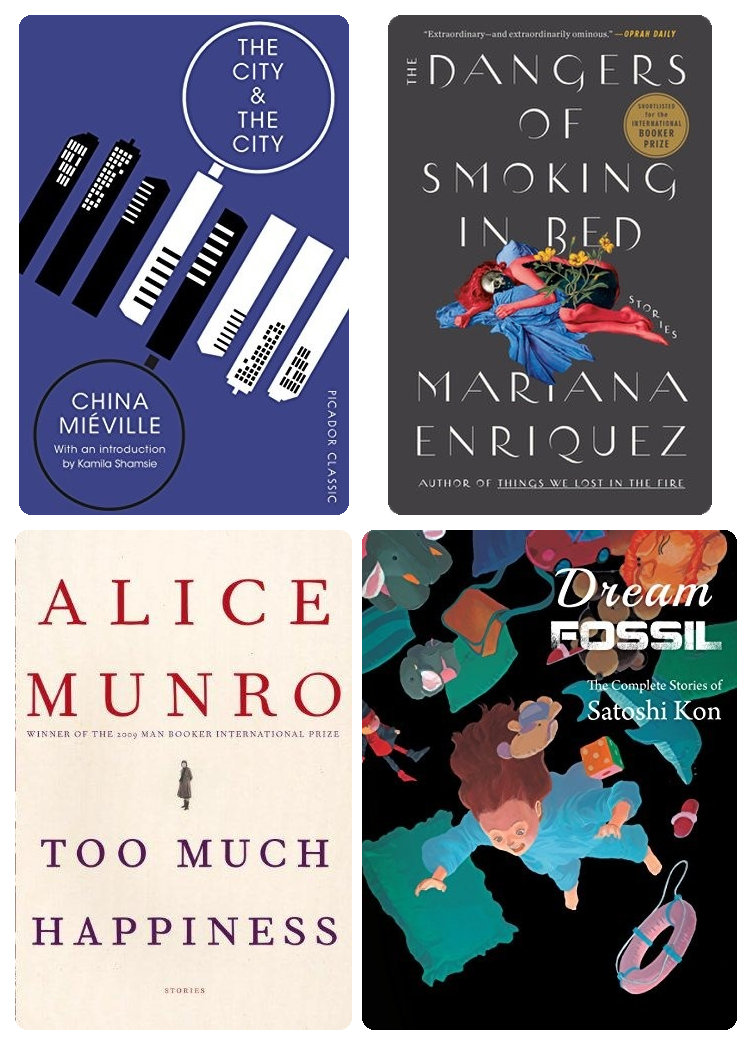
For my book club, Bay Area Book Friends – you should follow to find out about the next one! :) – our June book was The City and the City (China Mieville, 2009), a murder mystery set in two cities that occupy the same physical space but are nonetheless different countries. This was an immediately intriguing premise, and the book was a rewarding read. It was a page-turner, and I finished it almost entirely in one session because of how thrilling it was. I’m a sucker for gritty detective stories in which a tough-as-nails cop must go beyond the call of duty to solve a crime whose mystery goes all the way to the top, and any story of that shape executed well enough will have me hooked.
The premise of this world is that two cities, Beszel and Ul Qoma, occupy the same physical space – they are divided not by a border wall, but by the mental power of unseeing. A house in Beszel has a neighboring house in Ul Qoma, but everyone in Beszel conditions themselves not to see the Ul Qoman house. And I appreciated this, because unseeing is a core experience of urban life. While looking at your phone on the street, you unsee the other people walking, but you naturally move to avoid them. Whether it’s Beszel vs Ul Qoma or Mission vs Valencia, cities are collections of pocket dimensions created by our selective perception.
One non-obvious delight of this story is how procedural it is. A key theme in The City and the City is the importance of following rules. Physical boundaries can be enforced by border patrols and military force. But the unseeing boundaries separating Beszel and Ul Qoma must be self-enforced by every person. Even the unseen criminals are scrupulous about following the city boundaries. As a development economist, it’s hilarious to see the self-described poor city of Beszel be governed with watertight rule of law and state capacity that rivals Singapore. Large segments of the book focus on procedural details – the different rules under which a suspect can be detained without arrest, the system of police cooperation across the two cities, even the visa system is key to the story. This proceduralism plays roaringly well in a detective noir story, because the genre’s defining feature is rule-breaking. Our hard-boiled detective is the one man who is willing to bend the rules. Frankly, he’s way more rule-following than most detective protagonists, but within his universe he’s practically a cowboy. And in the land of proceduralism, the rule-breaker is king. A delightful read.
I have no idea how I discovered The Dangers of Smoking in Bed (Mariana Enriquez, 2009). I have a vivid recollection of my friend’s girlfriend recommending it to me. But when I thanked her, she informed me that she could not have recommended it to me – she has never read it herself.
It is diegetically appropriate for this book to have mysteriously wormed its way into my life. Because The Dangers of Smoking in Bed is a gothic horror anthology, about ghosts that haunt hotels and girls placed under curses by family witches and miasma on every street corner. I’m not a fan of supernatural horror – particularly ghost stories – so these stories often fell flat to me. But I loved the writing. Enriquez’s settings are rotten, her characters filled with malaise – yet her prose is energetic and descriptive, featuring gems such as this opening paragraph:
Silvia lived alone in a rented apartment of her own, with a five-foot-tall pot plant on the balcony and a giant bedroom with a mattress on the floor. She had her own office at the Ministry of Education and a salary; she dyed her long hair jet black and wore Hindu shirts with sleeves wide at the wrists and silver thread that shimmered in the sun. She had the provincial last name of Olavarría and a cousin who had disappeared mysteriously while traveling around Mexico. She was our “grown-up” friend, the one who took care of us when we went out and who let us use her place to smoke weed and meet up with boys. But we wanted her ruined, helpless, destroyed. Because Silvia always knew more: If one of us discovered Frida Kahlo, oh, Silvia had already visited Frida’s house with her cousin in Mexico, before he disappeared. If we tried a new drug, she had already overdosed on the same substance. If we discovered a band we liked, she had already gotten over being a fan of the same group. We hated that she had long, heavy, straight hair, colored with a dye we couldn’t find in any normal beauty salon. What brand was it? She probably would have told us, but we would never ask.
(If you recommended this book to me, please message me so I can thank you!)
But the standout book of my month was Too Much Happiness (Alice Munro, 2009). Each time I read Munro, it moves forward the day of reckoning, when I write an entire essay about her. Even though her stories are not very different from each other – let’s be honest – I find myself reading something different from them each time, a Rorschach test for my own obsession of the day.
Historically, I’ve read Munro as a writer who thrives in alienation. Her characters are alienated from the people around them, viewing all of them through reductive perspectives that are, unfortunately, absolutely correct. But I see now that her characters are routinely caught by surprise, their reductive models of other people failing when it matters most. In Fiction, the main character fixates on her former student who has grown up to be an author. She believes that the author has written a story about her specifically. But when they come face-to-face, the author doesn’t even recognize her. Our main character was just another figure in the pastiche of her life, a life that we will never grasp. More dangerously, this also applies to the relationship between the reader and her protagonists. Wenlock Edge ends with the main character enacting a terrible revenge against her friend, revealing a hatred that we never saw in her narration. I finished this book feeling a new humility, about the incomprehensibility of other people.
Too Much Happiness might be the strongest Munro collection I’ve read. It’s remarkable that 40 years after her first published writing, she was producing better stories than ever before. While accepting an Oscar at age 80, Akira Kurosawa famously said he didn’t feel like he understood cinema yet. Maybe it takes 40 years to perfect storytelling. Maybe it takes 80.
It pains me to do this, but I must give a dishonorable mention to Dream Fossil (Satoshi Kon, 2015). Satoshi Kon is the director of my favorite film, Perfect Blue, and a gifted artist who died too soon. So when I discovered that he had a posthumously-released collection of manga short stories, I freaked out and ordered it on the spot. Unfortunately, Dream Fossil is borderline unreadable. Kon’s character designs are too similar to tell apart on the page, and he can’t draw a comprehensible chain of events across panels. Even though his stories were interesting, it was such a headache to read them that I gave up after a few stories. Better to remember him as a director.
Movies
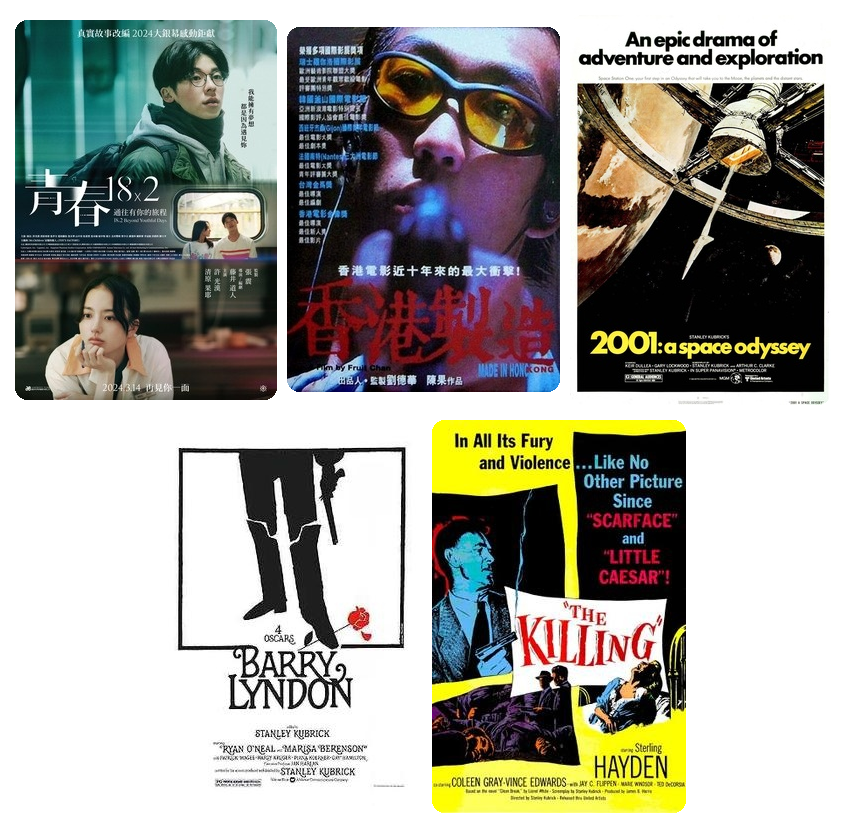
My June in movies began with a crisp white wine and a gentle evening of 18x2 Beyond Youthful Days (Michihito Fujii, 2024). When a Taiwanese video game developer is forced out of his company, he goes on a journey through Japan to reminisce about his young love – his present-day and past-life adventures running in parallel through the movie.
While 18x2 Beyond Youthful Days is an alright love story, it shines for its understanding of nostalgia. In my opinion, nostalgia has nothing to do with thinking about the past a lot. Rather, nostalgia is experiencing the present with vertigo, feeling that you’ve been here before, that the story of your life is a circle leading you back to the beginning. The past is not so much an object of focus as an inescapable destination. That is the kind of nostalgia that 18x2 Beyond Youthful Days wields. Our protagonist lives one life at 18 and another life at 36, but they blend together into one timeless plane for him. Maybe that plane is one he will re-experience at 54, too.
I also made my monthly Roxie pilgrimage to watch Made in Hong Kong (Fruit Chan, 1997), in which a delinquent teenager experiences his coming-of-age in the cramped flats and grimy streets of Hong Kong.
This fucking movie. How would I summarize it? Maybe with the scene where our protagonist is holding a knife in a public restroom, psyching himself up to stab his father. But before he can get it together, another teenager holding a knife walks into the restroom and starts stabbing his father, while the man is peeing. It is frightening, it is grim, and it is so fucking funny. Even though there is not the slightest hint of slapstick, everyone in the Roxie was howling. In another scene, our protagonist executes a contract killing and escapes like an action movie hero… except that turns out to just be in his head. In reality, he fails to pull the trigger, panics, and stumbles away like a loser. This is what makes him a wonderful protagonist; he wants to be a bad guy, but he’s just not.
I spent much of this movie lost in my own memories of adolescence. Even though my life was nothing like this movie, it captured a certain vibe so well that I couldn’t help but recall things I haven’t thought about in over a decade. It was a rare and precious experience.
BAMPFA has a Stanley Kubrick film series through August, and I am a baby bird that eats whatever Mother BAMPFA feeds me. So I dutifully bought tickets – but I wasn’t expecting to actually enjoy it. I was pleasantly wrong, starting with 2001: A Space Odyssey (Stanley Kubrick, 1968).
I vehemently disagree with anyone who says this movie is about vibes rather than plot. Yes, the aesthetics are nice, the depiction of space travel before the first moon landing would have been rapturous, the ending sequence is psychedelic. But to me, 2001: A Space Odyssey is only about plot. This is true in the same way that Aesop’s fables are about plot, or the Bible is about plot. The plot is central to the movie’s transparent goal – to engrave a new mythology of the human race into your limbic system. It’s rare to see such naked ambition in a storyteller. In my favorite book, a writer is hired by a mysterious publisher (who is totally not Satan) to write the founding text of a new religion. If that publisher hired Stanley Kubrick, the world would look quite different.
I found Barry Lyndon (Stanley Kubrick, 1975) remarkable, because it cavalierly breaks the rule I find most important in storytelling – that stories should have a natural escalation. As George Saunders puts it, stories are call-and-response systems. They introduce a complication, let the reader ask a question about how to resolve that complication, and then answer that question organically, perhaps introducing further complications to repeat the cycle.
Barry Lyndon doesn’t care what George Saunders thinks. An omniscient narrator tells us everything that will happen, before it happens; no questions necessary. The story is a familiar one. A provincial young man leaves his town and goes on an adventure in the wide world. With a bit of luck (but not too much) and a bit of skill (but not too much), he rises through the ranks of society (but not too much). Until – you’ll never guess this part! – his hubris leads to his downfall. That’s not a spoiler; the second half of the movie begins with the title card, “Containing an Account of the Misfortunes and Disasters Which Befell Barry Lyndon.”
Yet it works. It shouldn’t, but it does. It’s as if you pumped enough steroids into Joe Schmoe and he became Hercules. What should have been a regression became a progression. And it works because Kubrick embraces the fatalism so completely that the fatalism becomes part of the story. The suspense of wondering what will happen to Barry is replaced by the tiredness of having seen this film before. Just like 2001, Barry Lyndon lives in the realm of mythology rather than story, and it’s the embrace of cliche that lets it ascend to that realm.
I’ve said a lot of nice things about the other two movies, but my clear high point so far is The Killing (Stanley Kubrick, 1956), a heist movie in which an ex-convict drafts a team of everymen to commit a daring robbery – unaware that other people have discovered the plan, and are moving against them.
It’s a dead simple movie, with none of the sweeping narrative of 2001 or Barry Lyndon. But what it has is perfection. The knife dance of events planned and unplanned, a juggler tossing three pins in the air while a sniper lies in wait to shoot one of them. The swaggering puppetry of men who truly believe that they are immortal, inviting us to revel in their mortality. The tension that sits on your chest like a hammer for the entire fucking movie which surely breaks some film school rule but to hell with that. The dialogue that breaks the sound barrier as it cracks you over the head. All of these combine into the perfect thriller movie, one that soundly thrashes any thriller released today.
I love how you wrote about the Kubricks :)
18x2 sounds amazing, will so so definitely check that out.
I’m sad dream fossil didn’t work for you :( I was looking forward to reading it too what a let down!