
I’ve settled well into the rhythm of professional life: I travelled to DC and back for work, and I’m now in London for more work. But this is my longest roundup ever, so let’s get into it!
Books

The first book I read in July was Strangers Drowning (Larissa MacFarquhar, 2015), a collection of profiles of people MacFarquhar calls extreme altruists: people who go far beyond the call of duty to help others. They give their whole lives to it – to lepers, to animals, to abandoned children, whatever version of the good makes sense to them. MacFarquhar uses the profiles to understand extreme altruists – how do they balance their altruism against the other things a person owes, to their family, to their community, to the people in their lives? The book aims to be objective, and mostly is, though what that turns out to mean is that it holds admiration and judgment at the same time. Admiration for what these people do, and judgment for what they don’t do.
I consider myself altruistic, and I’m more motivated by altruism than most non-EAs that I know. Scott Alexander’s Fear and Loathing at EA Global 2017 inspired me as a teenager, and during my PhD I was never tempted to make an academic career by giving up on impact as a project selection criterion. But I have a relaxed approach to doing good. I trust myself; I think my natural inclination is to follow a path of doing good, and I don’t need to formalize or maximize anything to make that possible. I would go so far as to say that I’ve never made a sacrifice to have a higher impact. In contrast, MacFarquhar’s extreme altruists are paranoid about being less-than-maximally-impactful. To them, there seems to be no difference between “doing nothing” and “doing some good”, or at least they won’t accept anything less than “do literally every humanly possible good thing, subject to not dropping dead on the spot”. An interesting profile of an alien person.
I continued the Munro marathon from last month with Hateship, Friendship, Courtship, Loveship, Marriage (Alice Munro, 2001). I don’t have anything new to say about Munro since last month. From this collection, there are two highlights. First, the titular story sees two teenagers prank an older woman with fake love letters, with unpredictable consequences. Second, The Bear Came Over the Mountain is a twisted love story about a lifelong philanderer whose wife has early-onset dementia; in the nursing home, he has to watch as she takes up with another man. Both of these stories are outstanding.
This month, I went to an event where I had to bring a book I loved, and Goodbye, Eri (Tatsuki Fujimoto, 2022) was my only option. It is simply my favorite book.
On his 12th birthday, Yuta’s mother gifts him a video camera. But it comes with a price; she tells him that she is terminally ill, and asks him to film her final months. Warped, but okay. We see a montage of Yuta’s childish shots of his family and his life, stitching a heartwarming story about a family pulling together in the face of death. Then comes the day of his mother’s death. As he walks toward the hospital, the camera shakes. He turns around. His dad calls after him, but he will not look back, and he runs. And as he runs, the hospital… explodes? What kind of story are we reading?
But the camera pans out, showing you that everything you have watched so far is a movie – a movie called Dead Explosion Mother, directed by Yuta and screened for his middle school classmates. Disoriented, you piece it together. Yuta was actually given a camera; his mother was actually terminally ill; he did actually run away from the hospital; the hospital did not actually explode.
This disorientation sets the tone for the whole manga. Because every single frame in Goodbye, Eri is, diegetically, filmed by Yuta. There is not one frame from the point of view of an omniscient narrator. After a few readthroughs, you will finally clock that Goodbye, Eri is not a manga about Yuta – it is a movie directed by Yuta. There is a real story behind his movie, but we only see the story he chooses to show us; its correspondence to real events is unknowable.
But while a lesser story would treat this unreliability as a tragedy, Goodbye, Eri embraces it. Yuta’s version of reality may not be the truth, but it is beautiful. It reflects his goodness, his love. When we give up the burden of seeing the world objectively, we can embrace the flawed beauty of our own subjectivity.
I also read The Lover (Marguerite Duras, 1984), an autofictional novella about the love affair between a fifteen-year-old French girl in colonial Vietnam and a rich older Chinese man. Duras is an incredible writer, and she blends events into a single confusing stream of consciousness that feels like an actual childhood, remembered out of order because that’s how memory works. Her narrator is rich and complicated, and though the blurb makes her sound like an exploited Lolita, she is anything but.
But if Goodbye, Eri is about the wonder of flawed subjectivity, The Lover is about the misery of reductive objectivity. Duras cuts everyone in her life down to fit in the palm of her hand. Her best friend and her brothers exist as archetypes, without interiority. Worse, the person most lacking interiority is the eponymous lover. If you love someone, then the way you write about them will make them more interesting, not less. But Duras’s lover is boring. Who is he? A timid Chinese man, born into wealth he doesn’t deserve or know what to do with, who won’t stand up to his father to defend his love. Duras conveys nothing else about him; I guess she sees nothing else in him.
My preferred reading of this book is as a family drama. Because the only character who Duras doesn’t claim to understand fully – the only one who escapes her reductive glare – is her mother. Her mother is possessed by a madness that Duras doesn’t understand, loves her first son even though he is a psychopathic sadist, and has a suggestive relationship with her Vietnamese housekeeper that escapes Duras’s notice. As The Lover, this book was disappointing; as The Mother, it would be outstanding.
Honorable mention to American Psycho (Bret Easton Ellis, 1991), a book I abandoned because of how good it is. I can’t read this book for more than ten minutes without wanting to take a shower. Look at this totally typical excerpt:
Jean, my secretary who is in love with me, walks into my office without buzzing, announcing that I have a very important company meeting to attend at eleven. I’m sitting at the Palazzetti glass‑top desk, staring into my monitor with my Ray‑Bans on, chewing Nuprin, hung over from a coke binge that started innocently enough last night at Shout! with Charles Hamilton, Andrew Spencer and Chris Stafford and then moved on to the Princeton Club, progressed to Barcadia and ended at Nell’s around three‑thirty, and though earlier this morning, while soaking in a bath, sipping a Stoli Bloody Mary after maybe four hours of sweaty, dreamless sleep, I realized that there was a meeting, I seemed to have forgotten about it on the cab ride downtown. Jean is wearing a red stretch‑silk jacket, a crocheted rayon ribbon skirt, red suede pumps with satin bows by Susan Bennis Warren Edwards and gold‑plated earrings by Robert Lee Morris. She stands there, in front of me, oblivious to my pain, a file in her hand.
It’s too much clarity, too continuous of an insight into a degenerate mind. It is outstanding craft that I could learn a lot from, but it is not enjoyable.
Movies

My July in movies began with K-Pop Demon Hunters (Maggie Kang & Chris Appelhans, 2025). This movie was awesome. I assumed it would be TikTok slop, but boy was I wrong. To be clear, it is bad in the ways you would expect. It has the Netflix habit of restating the plot every ten minutes in case you were looking at your phone, and it is definitely a kids’ movie, with edgy-teenager dialogue that isn’t much fun to sit through as an adult. But the story underneath is so pure and heartwarming.
“You should accept yourself” is not a new idea by any measure. What makes this articulation work is that it shows you the consequence of not doing it: you fall under the spell of the first person who tells you they’ll accept your hideous flaws, and that you should be grateful to them for accepting what a monster you are. In K-Pop Demon Hunters, personal growth means rejecting the people whose love for you is conditional on you being a shell of a person. I did not expect to find Jungian psychology in the most popular kids’ movie of the year, but I’m not disappointed.
Immediately after K-Pop Demon Hunters, I felt the urge to rewatch Perfect Blue (Satoshi Kon, 1997). And… Perfect Blue is still a masterpiece. It is still insane to me that Satoshi Kon made a movie about the power of collective imagination and the internet to break your sense of reality and build false personas, in fucking 1997. When kids say “chat, what do we think”, they are reenacting Perfect Blue. We are all living in Mima’s Room, all the time.
But what Perfect Blue lacked for me is the emotional force of a first viewing. I’ve now seen it enough times that everything I’ve just said is something I understand intellectually, rather than a visceral experience. When I rewatched Burning in May, I had the same experience. I hate the idea that my favorite movies might be walled off from me forever, that the experience of watching them for the first time is something I can never get back. But I guess that’s something I’ll have to live with.
When I got back to Berkeley, it was time to continue the Kubrick series with Paths of Glory (Stanley Kubrick, 1957), a movie about a colonel in the French army defending three men against an offensively stupid court martial that threatens to kill them before German guns can.
After I watched this movie, a friend told me the most important criterion for an anti-war movie is that it should not have heroes. When the movie is about heroes who give their lives for the cause, cleansed by a hail of bullets, we can’t help but admire them, maybe even long for a cause that we ourselves would sacrifice for. When there are heroes, soon comes glorification, and glorification is death for an anti-war movie.
Paths of Glory does not believe in heroes. Its war is waged by medal-hungry generals whose lives are a sequence of chateau soirees behind the front line. There are virtuous soldiers who just want to do their best, but don’t let their virtue distract you from the fact that they are absolutely and totally powerless. They play by rules that everyone else snickers at. The only thing the meek will inherit is a crisis of faith.
Does that mean there is no point to being a good person on the frontlines, and that we should give in to cynicism? No. The small acts of humanity between soldiers pass on a hope that can multiply across the gloom of war. One testimony against a commanding officer, one tireless attempt to save three condemned men, one barroom song from a prisoner of war. All of these moments carry a hope – that one day, when we leave these paths of glory behind, we will bring our whole humanity back with us.
I finished the anti-war one-two punch later that week, with Grave of the Fireflies (Isao Takahata, 1988), watching two orphaned siblings struggle to survive World War II. I know this movie has a reputation for being tragic, but I left the theater with dry eyes. Tragedy is suffering that could have been avoided. But for some reason, the suffering in Grave of the Fireflies felt inevitable. So I bore witness to it grimly, and left the theater with dry eyes. I don’t feel good about that assessment, but I’m just going to move on.
Lolita (Stanley Kubrick, 1962) is outstanding. It’s unbelievably funny. The entire theater was in stitches during the opening scene, where Quilty insists on playing Roman ping pong before Humbert shoots him. Why is a movie about pedophilia so funny? Every moment just reads as absurd, even though every character plays it straight. Lolita’s mother ships her off to a summer camp called Camp Climax. Camp Climax! Sure, let’s run with it. Or when Humbert sips wine in the bathtub, quietly celebrating after Lolita’s mother dies in a car accident, and then the neighbors come in convinced that he’s grieving and about to kill himself. Sure, let’s run with it.
I don’t really understand how anyone comes away feeling this movie legitimizes the relationship. It is just so obvious that Humbert Humbert is a nothing man. He’s no towering intellect, he’s not attractive, he’s not charismatic. The only remarkable thing about him is his pedophilia, and even there the plot makes clear he is an amateur pedophile at best, while Quilty is a professional. Humbert? He’s just some guy.
Meanwhile, Lolita herself is outstanding. Not because she’s unusual; the movie is quite careful to make her ordinary. She’s a normal teenager with crushes, goals, passing interests. Like a normal teenager, she wants to grow up quickly. Part of growing up is having a crush on an older man whose only appeal is being an adult. Her crush on Humbert is real, but it’s temporary. She quickly gets bored and moves on when he reveals himself to be a man child, not the man of her dreams. She seems basically well-adjusted despite all the fuckery. But we would not know if that was a pretense. Her inner life would never breach the surface. He’s the one who turns out to be the child, throwing tantrums, forever needing his feelings managed. He was born a loser, and he dies a loser.
The first Indian movie I’ve seen in years was Aavesham (Jithu Madhavan, 2024), a Malayalam movie about three college students who befriend a local gangster, hoping he will take down their college bully. This movie was great fun. It’s over-the-top funny, and the stakes keep escalating without ever feeling stale. The gangster brings insane main character energy to every room he enters. Every move the students make is clearly a mistake in hindsight, but you’re right there with them and you get why they did it. They get into situations that are dark but also funny, tempting but also dangerous. They think they are invincible. They are not.
Aavesham is also special to me for being set in my hometown of Bangalore. The streets were nostalgic, and the scenes of daily life were familiar. There’s a bit where they all leave for Yelahanka, a faraway neighborhood. They start their journey during broad daylight, and I joked that it would be dark by the time they arrived. And it actually was. The movie never acknowledges this bit, leaving it as a little in-joke for the Bangaloreans. I’m sure there were other in-jokes that I missed, being only a partial Bangalorean. But it was a reminder that even after ten years away, there’s still a part of me in that damn city.
Borat (Larry Charles, 2006).
The Invite (Olivia Wilde, 2026) is a slow and predictable plot carried by outstanding drama. (Is it actually predictable, or am I telling on myself?) Seth Rogen and Olivia Wilde fight so well that you can’t help but wonder if they hate each other in real life. Penelope Cruz and Edward Norton bring a dash of mystery and menace. All four actors need to win awards for this.
I’m a sucker for letters. There are few things that give me as much clarity about my place in the world as writing a letter to someone I love. So I was primed to appreciate Love Letter (Shunji Iwai, 1995). A woman sends a letter to her dead fiance’s high school address, only to get a response from a woman with the same name as him, who was his classmate in high school. As they write to each other, a new story comes to light about his inner life that neither of them knew. It’s beautiful enough to discover someone once; discovering them twice is a privilege, and this movie treats it as such.
Other
Reality is a Camera Trick is a title I will be stealing for an upcoming story. But it is also a video essay by Jacob Geller, with an awe-inspiring thumbnail:
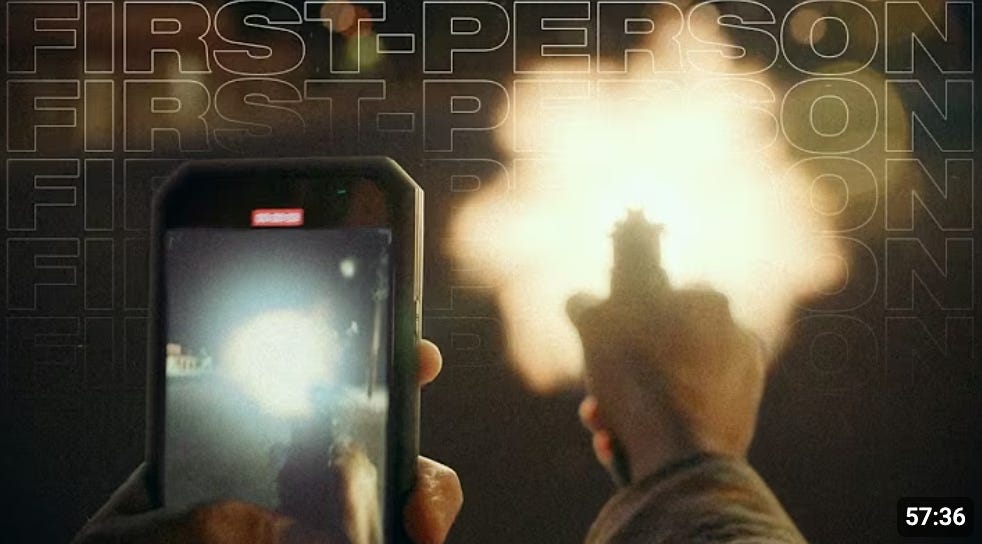
Geller analyzes a series of movies and video games that seem to mimic reality, but are actually mimicking cameras. The perspective of a camera is not our reality, but it somehow feels more realistic than reality. He covers how video games shaped our sense of what looks realistic, and how that has since fed back into movies, which now imitate the video game perspective – a perspective that was previously trying to imitate movies. It’s a mind-bending feedback loop of unreality.
(I see you writing that comment about Baudrillard. Hands off the keyboard!)
Reality is indeed a camera trick. There is no perspective-free world accessible to us in this life. It’s okay! You are the one behind the camera. Take some pretty photos and share them with the rest of us.
I like your musings about the spectrum of doing good from nothing to “do literally every humanly possible good thing, subject to not dropping dead on the spot”! It's interesting that that's become the impossible bar for being a "good person" or being "moral" in a lot of circles, EA and otherwise. I wonder if more people would be good if their definition of good was more relaxed.
I also thought The Lover was more a book about a mother than a lover (and found it even more about mothers than "Is Mother Dead?" which I read right after lol). Agree with you how frustrating it was that the lover lacked any interiority. I know it's to serve a purpose to the function of memory but to me it just felt a little racist..?
Is it perverse that your description of American Psycho makes me want to read it even more (same with Lolita lol)? Might finally get to reading BEE... I unfortunately do love that movie, though it is quite a grotesque one. Have you seen it?
Haven't seen the movies I love enough times to dread watching them (and am actively avoiding rewatches for this reason)... I hope the day never comes T_T