
We face a double bind when connecting with other people. On the one hand, it’s important to see them as they are, rather than imposing our own assumptions about who they might be. On the other hand, we can’t actually see people as they are; we can only see the tiny sliver of themselves that they reveal to us, with their totality being too vast for us to ever see. So we have no choice but to lean on our imperfect views of them.
This double bind feels like a curse, a lonely confirmation that we are all doomed to misunderstand one another. But it is actually the source of vitality in our relationships. It is the illegibility of other people – their capacity to slip out of the boxes we put them into – that gives relationships the spark of life.
Happy Hour is a 2015 film by Ryusuke Hamaguchi, about a friend group of four Japanese women navigating the difficulties of marriage and friendship. Hamaguchi is one of Japan’s best-known working directors – his 2021 film Drive My Car was nominated for Best Picture at the Oscars – but Happy Hour remains obscure in the US, where you can’t even find it on streaming services.1
I’m not surprised; Happy Hour is an unusual movie. It runs for over five hours, it stars non-professional actors who have never been in another movie, and it consists almost entirely of long conversations with no action.
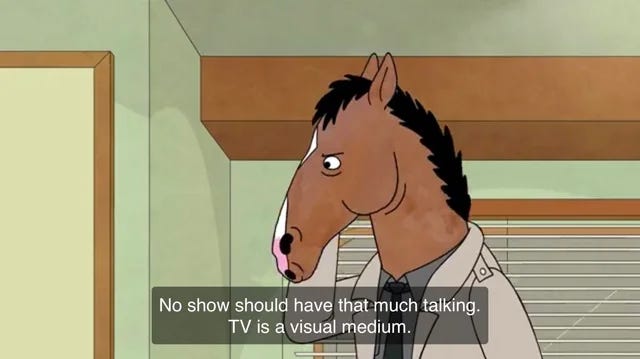
Still, Happy Hour is the greatest depiction of friendship I have seen – one that helped me realize that loving someone means letting them surprise you, over and over again.
Don’t try to make yourself small for others
The narrative kickoff of Happy Hour comes when one of the friends announces to the others that she is divorcing her husband. But this announcement takes place almost ninety minutes into the movie. Most of the time before that consists of a single scene, where the four friends participate in an improv workshop.
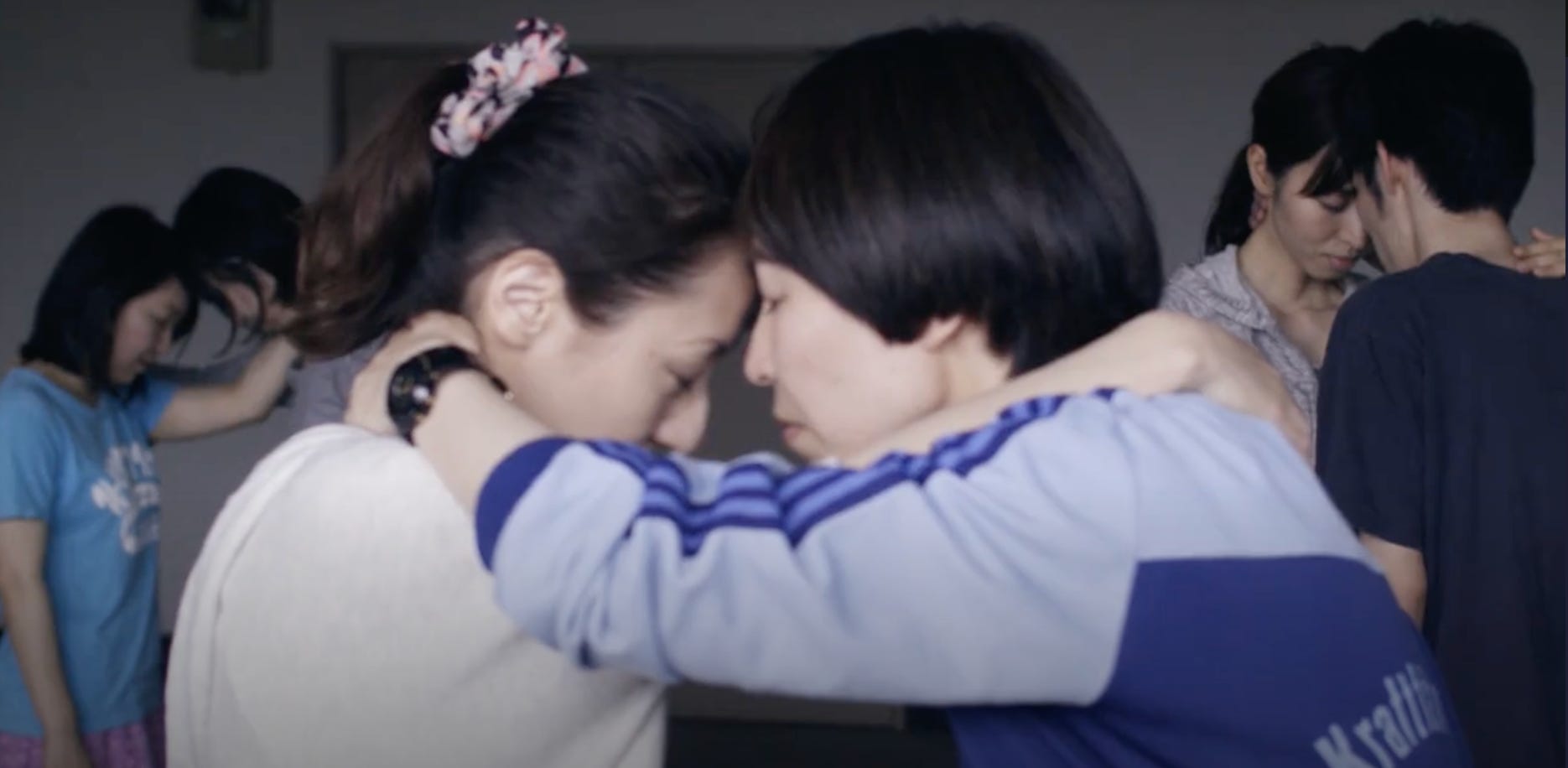
The premise of the workshop is to “listen to your center”. The conductor is an eccentric artist who became famous by balancing miscellaneous objects in unusual ways, like making a chair stand on one leg. He takes them through a series of somatic exercises, starting by having them sit with their backs to each other and try to stand up by using each other as support. “You don’t know your own size, but you have to convey it to others,” he tells them. “Don’t try to make yourself small for others,” he adds. “It won’t work.”
Over the next thirty minutes of the film, the exercises get increasingly intimate. The participants put their ears to each other’s stomachs. They align their bodies and move in a circle. They touch foreheads and try to transmit thoughts to each other. These startling intimacies are how we first get to know our four protagonists, and the extended scene gives them each a specific characterization.
Akari is the speaker of truth. She is a nurse, and the only friend who is single. She is confident in speaking her mind, and she stands up for her friends. But she is also judgmental and sees people in black and white. She isn’t comfortable with her own feelings and flaws, which makes her uncomfortable with other people’s feelings and flaws. She wants her feelings to fit into tidy containers, to be dispensed only at will, and is unsettled to learn that these containers might overflow with her. “I’m a nurse, so I touch patients all the time,” she says when debriefing the workshop. “It never occurred to me that the patients may be feeling what I’m thinking that day. I feel alarmed about that.”
Sakurako is the chrysalis. She is a housewife, and the most timid of the friends. She has a teenage son and a workaholic husband; neither of them pay her much attention, but both of them expect too much from her. She gets nervous when paired with people; when she touches foreheads with another workshop participant, she finds the intimacy so embarrassing that she avoids him afterwards. She wants to be understood, but she doesn’t know what about herself she wants to be understood. “I wasn’t completely sure what we were doing, but I was trying to listen to others and others were listening to me,” she says after the workshop. “That was a nice feeling. It’s rare when others are willing to listen to you in everyday life.”
Jun is the instigator. Not only does her divorce announcement trigger the events of the movie, she also brings provocation to all of her relationships. In high school, she set up Sakurako with her husband, by telling each person that the other liked them. After the workshop, she sees that Akari has chemistry with the workshop conductor and nudges them together. At the workshop, she approaches every exercise with intense openness, whether paired with her friends or with a stranger. Every time she looks at another person, her eyes are wide open. “Simply touching others was really fun,” she tells the group afterwards. “I didn’t think deeply about what we were trying to achieve. I could drive myself crazy if I did.”
Fumi is the stoic. She is an art curator, and the most reserved of all the friends. She doesn’t even participate in the movement workshop; while her friends are listening to each other’s stomachs, she takes photos from the outside. When they try to listen to her stomach after the workshop, she pushes them away. In the first hour, you learn almost nothing about Fumi’s inner world, by her design. She is in touch with her feelings; her silence comes from the belief that not all feelings need to be expressed.
After the workshop, all the participants go out for a happy hour. At this table, Jun casually brings up – to her friends and to a group of strangers – that she has been in divorce court for a year. She states undramatically that she has been cheating on her husband. She expresses no remorse when reproached by Akari, who is herself divorced from a cheating husband. Jun kept the ongoing divorce a secret from her friends for almost a year. But she has finally stopped caring about what other people think of her. The end of her shame is the beginning of the quartet’s collective journey.
Like Hamaguchi’s other films, Happy Hour is full of complex romantic relationships, infidelity, and emotional growth through conflict. But unlike those other films, Happy Hour is about the magic of friendship. Our four protagonists do not, and could not, navigate their relationships alone. They stand up to each other’s husbands, stay in the hospital with each other, and call each other out when they’re being unreasonable.
What makes this friend group so compelling is that it is not based on some innate similarity. The four women are quite different, and they butt heads often. Akari doesn’t hold back her contempt after hearing that Jun cheated on her husband and kept secrets from her friends. Fumi tells the others that she doesn’t talk about her feelings because she thinks they will judge her. Sakurako often feels ignored even within the group. Jun is openly dismissive of the others’ attempts to police her behavior.
Yet this clash of personalities is exactly what makes their friendship so important. Each woman brings her whole self to the friend group, rather than compressing herself into a social role. Each woman knows that she has a blind spot that the others can see; each woman knows that the others love her even though they can see her blind spot.
I’ve quoted Ava‘s line on friendship so many times that I know it verbatim:
Friendship is what taught me that love is an endurance sport with no finish line. You keep picking up the phone and sending dumb texts and ordering crudo and white wine at New American restaurants and watching movies and asking about their parents and sometimes things change and sometimes they stay the same. Disenchantment, reenchantment. In this way romantic love and platonic love are the same. As long as nobody quits, we’re still in it together.
When the four women take a trip to a hot spring town, Fumi sees her husband Takuya taking a walk with Kozue, the young female writer he serves as an editor for. She knew about this meeting; there is nothing inappropriate about it. But Fumi still registers a fleeting anxiety when she sees them. Because more than at any point in the movie so far – more than during any time we’ve seen him with his wife – her husband looks relaxed.
The others notice the same thing as her, but they don’t say anything at first. They only bring it up later, when all of them are relaxing after a soak in the hot springs. Without a tremor in her voice or expression, Fumi stonewalls them. Unlike them, she says, she doesn’t need to always talk about her feelings. They are judgmental, and shouldn’t interfere with her marriage. She stops short of calling Jun a divorce influencer, but her meaning is clear: don’t think you can mess with my marriage the way you’ve messed with yours.
But instead of getting angry or defensive, the other three make jokes. Then they climb onto Fumi and put their ears to her stomach. Gently but insistently, they envelop her in a group hug, and put their ears to her stomach.
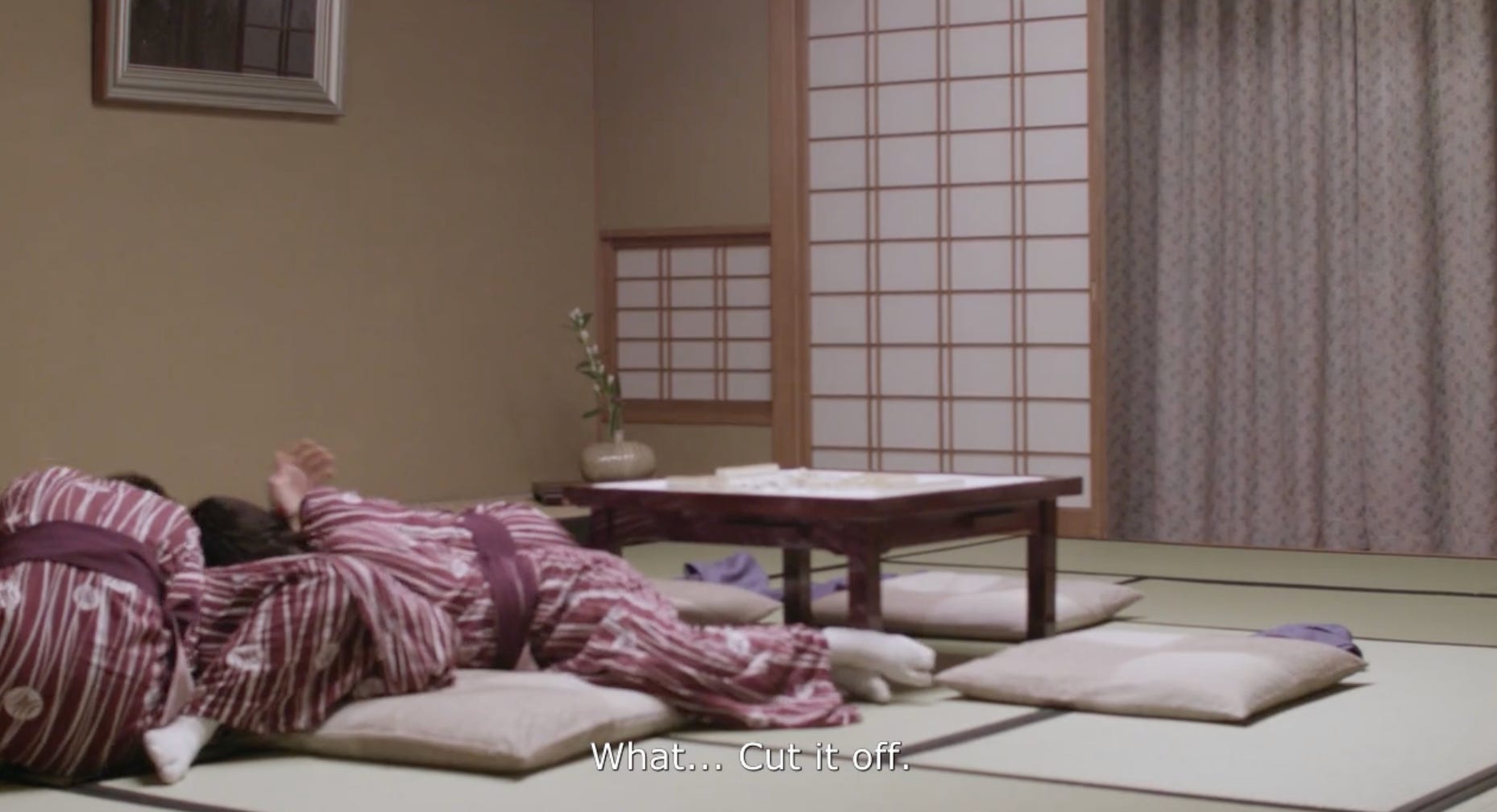
Fumi learns three things in this scene. First, her anxiety was valid, because her friends had the same reaction that she did. They give her the confidence to hold on to that anxiety, rather than to tell herself that she is overreacting. Second, her friends understand her feelings even if she doesn’t want to talk about them. Third, her friends won’t judge her or give up on her just because she snaps at them. Wouldn’t any of us be lucky to have friends like that?
Staying in one body, arriving somewhere else
What makes Happy Hour different from other movies about friendship is a buried philosophy that pervades Hamaguchi’s movies. It’s a view that is only revealed obliquely, through an accumulation of small surprises in ordinary conversation. This kind of oblique revelation is a signature feature of Hamaguchi’s filmmaking, and to help you see it, I have to walk you through a particular scene.
Three and a half hours into Happy Hour, we witness a reading by the young writer Kozue. In her story, a young geologist visits a hot spring town with her married professor, while simultaneously grappling with her feelings for him. Her discussant is Jun’s estranged husband, Kohei. He is an audience member who was called on to be a discussant at the last second, after the intended discussant bailed.
Kohei: Nice to see you. It’s been a while.
Kozue: Hello, and thanks for filling in.
Kohei: I’m not sure how to begin.
Kozue: Yes, of course, I understand.
Kohei: The book isn’t out yet?
Kozue: No, the ink is still wet on my manuscript.
Kohei: Not dry.
Kozue: Yes. It’s part of a series with a hot spring theme. Hot springs like Atami and Beppu and Arima near Kobe.
Kohei: So the others are yet to come out yet?
Kozue: That’s right.
Kohei: I don’t think I’ve said yet who I am, have I? I was introduced as a biologist, but my specialty is in fertilized egg development.
Kozue: Yes, I had heard that. What kind of research do you do?
Kohei: Well. Put simply, I observe fertilized egg cell division, and how cells acquire functions. We all know we have arms here, and legs there. And organs in our abdomen. We take it for granted. But should we? Why don’t our hands and heads grow from our bellies? I’m studying when and how these functions are determined. Currently we only know that it is ultimately programmed in our DNA. Evolution showed that our four limbs worked best in this form and so here we are with that DNA. That’s all we know. When and where do cells take on a role as they divide? It’s a key question: when an arm becomes an arm or a leg, a leg from what was once just an egg? Can an arm cell replace a leg cell? If so, in what cell process is that possible?
Kozue: Ah.
Kohei: Is it hard to follow?
Kozue: No, but I might be lying if I say I understand.
Kohei: It is difficult, I know. But it becomes false if I oversimplify. Putting it at its simplest: I scrutinise how things happen.
Kozue: Now I remember that I’ve heard you explain this before.
Kohei: That’s right, with the same response.
Kozue: I’m sorry. But then, what you do is not so different from my work.
Kohei: I think that’s what you said then too.
Kozue: I’m sorry.
Kohei: No, I agree with you.
The conversation begins with a surprise: Kohei and Kozue know each other. We have never seen them interact, and we have no reason to think that they know each other. One is a biologist, the other is a writer, and they have only the most indirect of mutual friends. So the fact that they have already crossed paths is our first sign that there is more to these two people than we know.
Why include this detail? It primes us to expect some deepening of their entanglement, maybe a conflict or a relationship in their past or future. But this does not happen. Their history is never brought up again, and they have no relationship after this conversation. This detail simply lets us know that this world is much bigger than our limited window, that these characters have stories that we will never hear.
Despite their acquaintance, the conversation starts disastrously. In the film so far, Kohei has been established as a frigid man, self-obsessed and unable to empathize or talk about feelings. He did not come to the reading because of his acquaintance with Kozue or because he was interested in literature; he came to chase down Jun. True to expectations, he begins by rambling about himself, while Kozue listens politely and does not engage.
Kohei: May I talk about how good your story is? I think it’s great.
Kozue: Thank you.
Kohei: It was new for me to approach literature through voice. The main character is Yayoi, a woman in her 20s like you. It’s her first-person narrative. It’s embarrassing, but I felt like I had become a woman as I listened.
Kozue: Really?
Kohei: Yes, honestly. How embarrassing.
Kozue: No, I’m pleased.
Kohei: Women are always a mystery to me. But I felt like I had become one. But, it hasn’t solved the mystery. I really felt how women perceive their own bodies as a mystery. It’s thanks to your vivid portrayal, your ability to see. You open with visual descriptions: one of a train.
Kozue: Yes, Arima Railway.
Kohei: I thought it symbolised the whole work. Things often just pass our eyes by. But your eyes don’t try to catch those fleeting events. They depict them as something fleeting. I thought that was terrific. It isn’t in slow motion; it’s our real time, the world as it is. You show how sensitively that can be done if you try. Put simply, it’s beautiful. It spurs us to live life. That’s my reading of it.
Kozue: Wow, that’s great.
Kohei: Did you visit Arima?
Kozue: Yes, I did.
Kohei: I thought so. The story is based on what you felt there?
Kozue: That’s right. The train and the hot spring are much like I experienced them. The characters are fiction.
Kohei: I’m not so sure about that.
Kozue: Why is that?
Kohei: It’s related to the other strength of this story. How minutely you have documented your own perceptions, from vision to perception. That’s unique to this work.
Kozue: Really?
Kohei: So many things pass by Yayoi’s eyes, but they still have an impact on her. I felt this seemingly calm story was really very dynamic. Because Yayoi undergoes such a radical change. She affirms the bent knee she was ashamed of, through seeing. Listening to you, readers – or rather listeners – could take on Yayoi’s body. They could enter her senses. It was almost like being in the women’s section of the bathhouse. It really was. It was a first for me.
Kozue: I’d be worried if it wasn’t.
Kohei: Listening to you yourself read the story was even more fascinating. It was like you, Yayoi and all of us merged together in this space. It was a happy moment.
Kozue: Wow.
Kohei: Excuse me. I’ve done all the talking, when we all came here to listen to you.
Kozue: No, really. Thank you.
Out of nowhere, Kohei starts talking about Kozue’s story. And he’s... actually quite perceptive? Even though he only showed up to hunt down his runaway wife, he listens carefully to the story, even before he was asked to be a discussant. He wonders at his brief immersion into the experience of a woman in love in a hot springs town, experiencing the sensations from the story.
The minor surprise of the preexisting acquaintance gives way to the major surprise, that Kohei has depths to him not explored in the three hours before this scene. We previously thought he didn’t care about women’s feelings; now he is describing, with genuine wonder, what it felt like to inhabit a woman’s body through fiction.
Kohei: Do you have any comments in response?
Kozue: No, I’m just grateful. But...
Kohei: Yes.
Kozue: If people equate me with Yayoi, I must object and say that that’s not the case. Although it’s a fine balance. I did invest Yayoi with many of my own feelings. But I also have to be Akane, for example. I’m not a multi-role player, but with multiple characters I have to make them all real. I have to be Akane, and Shimada, and Ogata too. But if they’re all me, then it’s completely boring.
I really like this world. It has its bad sides. I’m not enlightened enough to include those, too. But all together I like it. So I don’t want to demean it in my work. There’s the fact that the world’s a lot bigger than me, of course. But it’s also only me writing. So how do I represent the world and not just myself? In fact, I make myself as small as I can. I become tiny and ignorant. Yayoi represents me. What she doesn’t know, I don’t know.
What occurs is so minor you can’t call them events. But for her, all of them are sudden and surprising. I am there with her in every response, like emerging from a tunnel. Staying in one body, I wanted to make her arrive somewhere else.
Kohei: I think you did that, and we joined in that journey. But...
Kozue: You have a but.
Kohei: No, that’s it from me. I’ll talk too much again.
Kozue: No, please go ahead.
Kohei: May I take questions from the floor?
Now the focus of the conversation shifts to Kozue. Until this point, we’ve barely heard full sentences from her. Her story seems like garden-variety autofiction that you might find littered across Substack. But when pushed with that idea, she reveals a more nuanced philosophy of writing.
Kozue points out the obvious limit to autofiction: if you only draw characters from yourself, then you end up making every character the same. That is both boring, and dangerously reductive of the world around you. Nor is autofiction always an option – this is a particular concern for Hamaguchi himself, a male director making a movie about women’s interiority. Kozue’s solution – to make her characters small and ignorant, so they can be surprised by other people – echoes the feeling Kohei expressed, of being surprised by her writing.
Kohei has more thoughts, but he holds them back in another unexpected show of consideration, and the conversation ends. More audience questions ensue, the reading ends, and the conversation resumes at a post-reading dinner convened by Takuya, Fumi’s husband and Kozue’s editor. He goes around the table soliciting feedback on the reading, until he lands on Kohei again.
Takuya: How about you, Kohei? You had something else to say, didn’t you?
Kohei: No, I thought it was a great story. That was my first comment.
Kozue: Thank you. What’s the second?
Kohei: Well. I’m just an amateur, so I can only comment as one.
Kozue: Okay.
Kohei: The main character, Yayoi. She doesn’t really love anyone does she? At least that’s what I felt. Shimada isn’t really important to her at all.
Kozue: Where did you feel that?
Kohei: If you’re really in love, you can’t hide it away inside yourself. If you really want someone, an unknown you rips through and appears from your old self. And I thought that Yayoi, the main character, didn’t really love Shimada, the male character.
Kozue: So you’re saying that maybe I, the writer, haven’t ever really fallen in love with anyone.
Kohei: Characters are not the authors. You yourself said so, and I agree with that. But your work aims to transplant your physical senses into your text, accurately and faithfully. The limits in the writer’s perception can become the limits of the world shown in the work.
Kozue: Because the writer doesn’t know how it feels to be in love, so her world is narrow?
Kohei: I thought so. Doing anything to grasp what you see passing by. Trying even when it’s futile. I didn’t find that emotion in your story. As far as I can see, the world is much crueler. Like wind blowing through trees, the most precious things can suddenly be stolen away. Writing that reproduces the world’s cruelty – I just realised that that is what I want to read.
Takuya: I think writers should never write in response to orders from their readers.
When Kohei is pushed, he reveals his true feelings. At first we thought he was self-absorbed; then we learned he was thoughtful and sensitive; but at this dinner table, we learn that he is imperial.
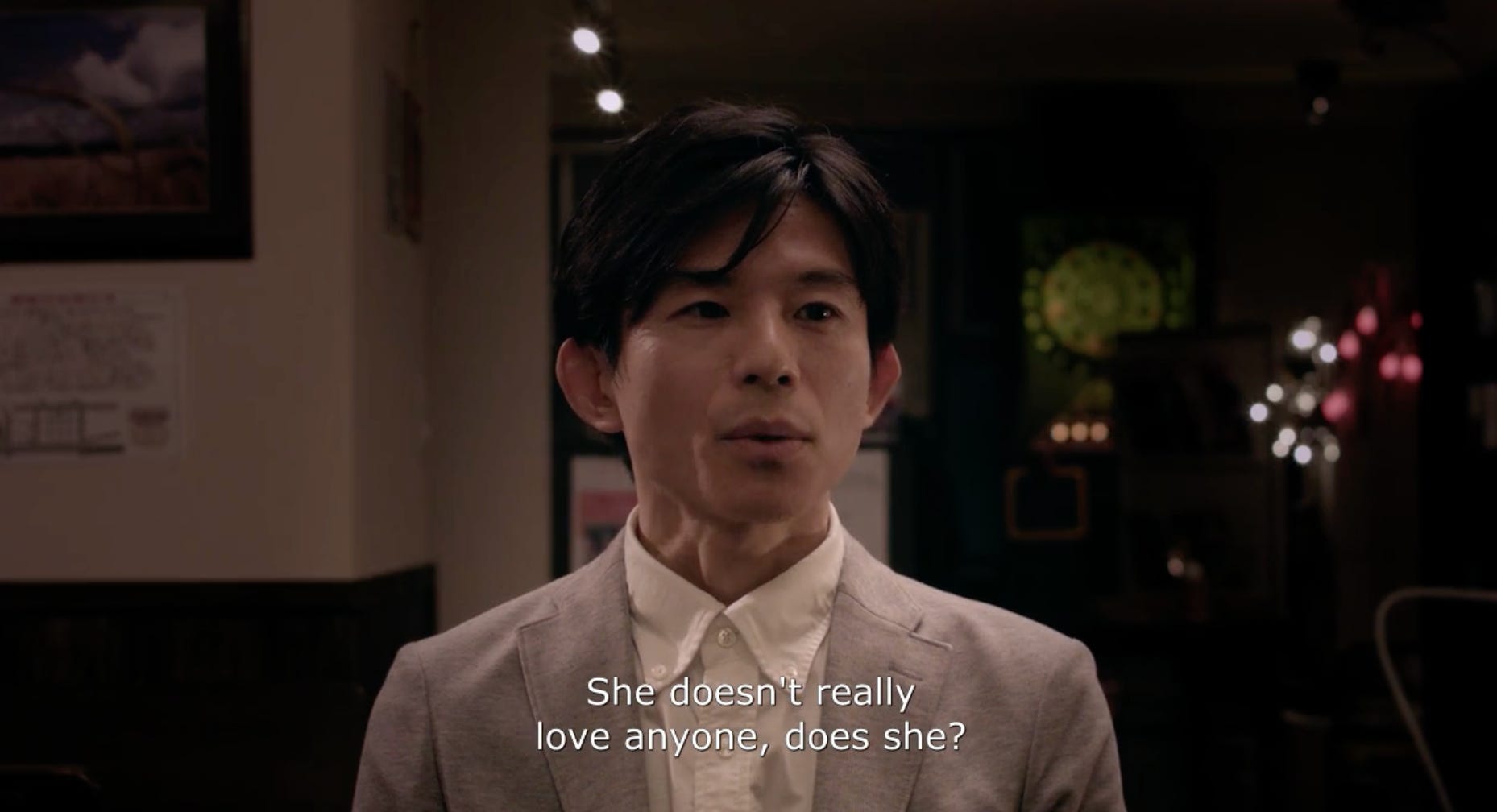
Kohei sees love as an aggressive force, tearing through all niceties and rules to get what it wants. His digression about being a biologist doesn’t seem like such a digression anymore. His love is Darwinian. His passion is red in tooth and claw. You understand why Jun is hiding from him.
When Kohei claims that Kozue is not just writing fiction, he is more right than he can know. In reality, she visited the hot spring town with her married editor Takuya before writing a story in which a young woman pines for her married professor. Even though we never see them interact in private, it doesn’t take much to infer the emotional core of her story. It’s no wonder Kozue is so shaken when Kohei says she hasn’t experienced real love after reading her story.
Takuya: However immature they are, writers must build their work with their own knowledge of the world. If they don’t, they have no roots. They can’t grow. I like her work. As her editor, perhaps I shouldn’t say this.
Kohei: Go on.
Takuya: What I trust most in her is that she doesn’t dive into definite themes like “cruel world”. She depicts the world as she sees it. That is at her roots. She might not know about a whole lot of things, but if your cruel world ever appears in front of her, she will write it as it is.
Kohei: I look forward to that.
Takuya: So do I. Sorry, I butted in.
Kohei: Not at all. This amateur made stupid comments.
Kozue: Not at all, thank you. But… it’s a shock.
Kohei: I’m sorry.
Kozue: It’s okay. That “love” was something I felt confident about. I’m not sure what to do if it isn’t true.
Kohei: I don’t know. You’re still maturing. You’ll suddenly realise what kind of person you are.
Kozue: Is your wife the person you really love?
Kohei: Yes.
Kozue: That’s great.
Kohei: No. We were just in divorce court.
Takuya’s interruption escalates the emotional dynamics of this conversation. Whenever he talks to his wife Fumi, Takuya tends to be soft-spoken, unexpressive. We previously pegged him as a quiet guy. But by pulling out eloquence we didn’t know he had, he spells out his feelings for Kozue more clearly than any explicit confession. It’s not like he could make a confession: at this point, he is not even aware that he has feelings for her. But Fumi, ever the perceptive one, is aware. She is also at this dinner table, and her simmering silence is key to this scene.
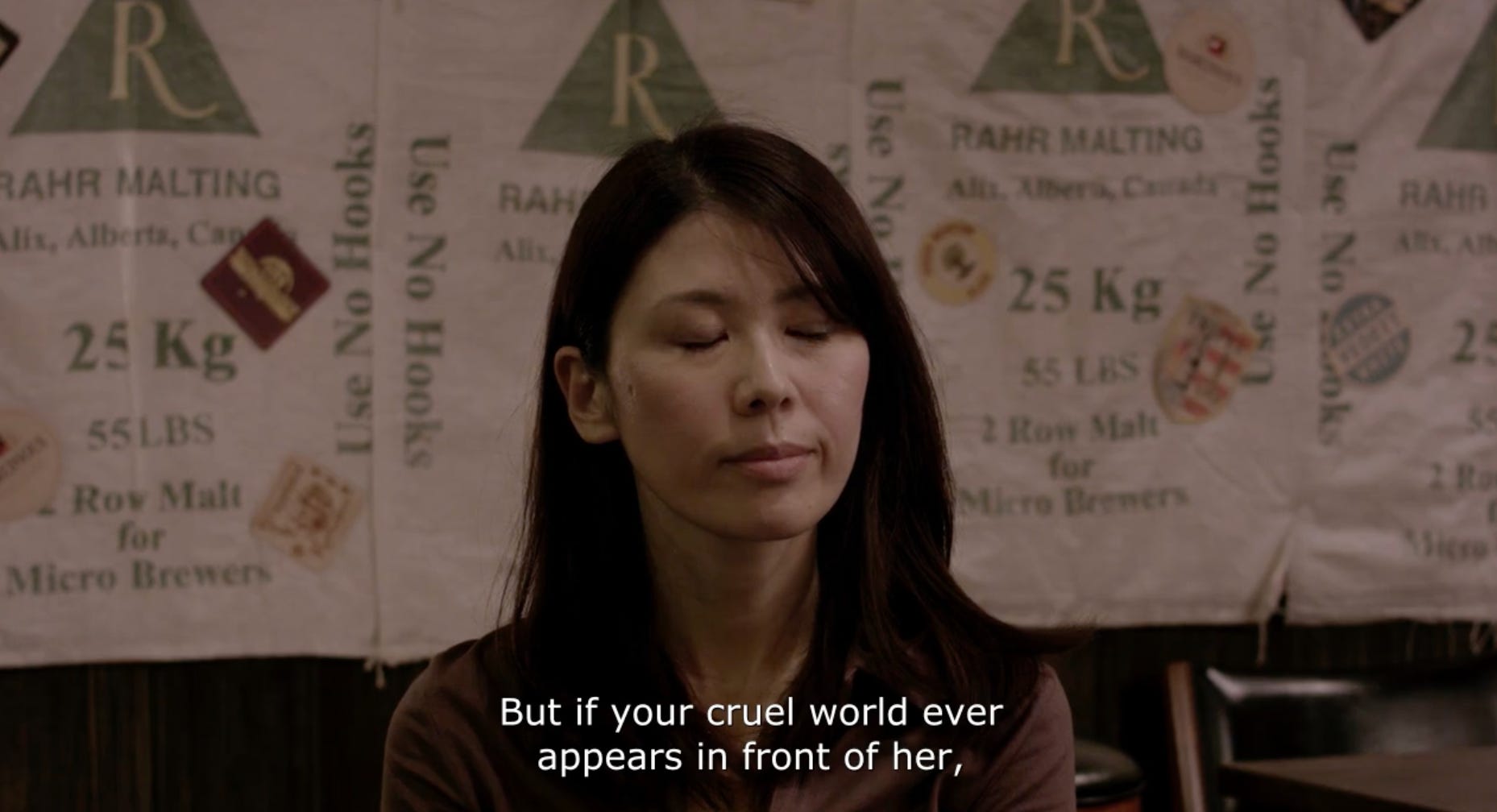
By the end of this scene, the mundane dialogue conceals how much we’ve been taken by surprise. Kohei, the frigid husband, surprised us as a sensitive reader, and then surprised us again as a bloodthirsty lover. Kozue, the young writer of barely-concealed autofiction, surprised us with a nuanced philosophy of writing. Takuya, the soft-spoken editor, surprised us with an implicit confession of feelings for Kozue. Three characters we thought we knew showed us depths we couldn’t have guessed at. And all of this happened through ordinary, understated conversation – just people saying more than they intended to.
So why did I make you sit through 1500 words of dialogue?
Film is different from literature. In literature, we have privileged access to people’s internal states. Either we have an omniscient narrator who tells us how people feel, or we have a subjective narrator who tells us how they feel. But in film, we see only people’s external states, their face and voice and spoken words. The camera cannot show us a person’s interiority. There is a fundamental gap between what we can perceive and the person on the other side of the camera.
Most directors and actors treat this gap as a limitation to be overcome in making great cinema. Directors write stories that spell out people’s interiority, and actors paint a vivid canvas of that interiority. But Hamaguchi realizes that our lives share this problem with film. The gap between the camera and its subject is the same as the gap between our own perception and other people.
So instead of being discouraged by this gap, Hamaguchi treats it as an opportunity. He wants to give us the universal experience of being tiny and ignorant, of being caught by surprise. That is why he writes characters who we can only partly understand, characters who are legible but never summarizable. When they speak, they point a flashlight into a vast subterranean city. We can see the flashlight beam, but what really sticks with us is the depths that it hints at.
It is only because we can’t know these characters that we can be surprised by them. We stay in one body, but we arrive somewhere else. This is Ryusuke Hamaguchi’s magic trick.
Acting in front of the camera
The acting of Happy Hour is unusual. It is understated, even flat. Divorce ultimatums, friend breakups, confrontations over feelings are all delivered in a near-monotone. This is not because the leads of Happy Hour are bad actors. It is because they are not (professional) actors at all.
Happy Hour grew out of a workshop conducted by Hamaguchi in 2013, with the four women as non-professional participants. He developed the script in response to them, but he never trained them as actors. In fact, his method of directing is to order his actors to just read the script. He doesn’t want them to perform a character; he wants them to read the script with as little emotion as possible. This is why the conversations of Happy Hour are so undramatic.
This does not make their acting objectively worse, or objectively better. But it presents a very different type of acting – one that’s uniquely suited to my particular obsessions.
The camera cannot show us what goes on inside a character’s head. Professional actors use their skills to close this gap. They use their voice and expressions to paint a rich picture for us, a canvas of extreme clarity into their character’s inner world. But the amateur actors of Happy Hour offer no such bridge. You can feel the distance between the actors and the camera, and you often have no clue what the characters are thinking.
But the reward for this understatement is that what remains is real. When Akari confronts Jun for lying about her divorce, the haughty scorn in Sachie Tanaka’s voice is not performed. It is the feeling that she can’t suppress, even when Hamaguchi instructs her to read the script without feeling. Akari is a fictional character, but she is made real by the cracks in Sachie Tanaka’s performance. It is these cracks that make Happy Hour real in a way that most movies are not.
The critic Masato Hase writes:2
Happy Hour therefore possesses a distinctive appeal that cannot be grasped by interpreting the content of the “work” this way or that, or by judging how successfully it functions as art. Put simply, its appeal comes down to the fact that its four female protagonists appear extraordinarily compelling. This is not only because Akari, Sakurako, Fumi, and Jun are portrayed as compelling characters within the story. Rather, the four women who play them - Sachie Tanaka, Hazuki Kikuchi, Maiko Mihara, and Rira Kawamura, all workshop participants - are overwhelmingly compelling. Their presence radiates from the screen with a mysterious brilliance whose source we cannot identify.
Yet it also seems wrong to say that we are responding to the appeal of these four women as actual people. Documentaries and television programs featuring nonprofessionals sometimes introduce people of tremendous appeal, but those people simply and naturally expose themselves as they are to the camera. The four real women in Happy Hour, however, never show us their everyday, natural selves from beginning to end. They simply perform, all the way through, the fictional lives of Akari, Sakurako, Fumi, and Jun. We therefore know nothing at all about what these four actual women are like, or even how they ordinarily speak. Nevertheless, we sense an appeal that exceeds their roles.
The women of Happy Hour have the power to surprise us, because we don’t know where their amateur performances end and their real personality begins. While professional actors give us clarity, Hamaguchi’s amateurs give us the all-too-relatable confusion of trying to see another person under their mask.
The quality of seeing
Hamaguchi builds his films around the gap between the camera and its subject, between what we perceive and who people really are. One character in Happy Hour embodies that subjectivity more than any other.
Jun is the most mysterious of the four friends. She is the one who initially introduced all the friends to each other. She triggers life changes in her friends, but none of them seem to have any impact on her. She hides important secrets from them throughout the movie. I’ve even heard the bizarre argument that she’s a malicious force, a divorce influencer aiming to wreck her friends’ marriages. This is nonsense, but it’s understandable. Because Jun is something unsettling: a person who does not care what anybody thinks about her.
In an interview, Hamaguchi once said:3
The people I dislike are those in whom I sense a desire to ingratiate themselves… I do not feel at all that I am making contact with something in the person… If talking to someone makes me feel that the person does not respect themself, I come to think there is no point in continuing the conversation.
Jun is the polar opposite of this. There is not a single person in the world she wants to ingratiate herself with. She spent eight years suppressing her nature to prop up her marriage, and she is no longer willing to do that. Nor does she feel the need to explain herself to anyone, even the people she loves.
Jun is fighting to divorce Kohei, but without no-fault divorce laws, she struggles to win. He did not cheat on her; in fact, she cheated on him, which does not bother him at all. He did not physically or emotionally abuse her. He simply ignored her for eight long years. That is the life that Jun will never, ever go back to.
Jun has a charisma unique to people who know exactly who they are; people who never make a decision that feels wrong to them. I envy that. Sometimes all my decisions feel wrong at the same time, an impressive kaleidoscope of wrong, wrong, wrong. And Jun’s unfiltered self is remarkable. She cares about people and witnesses them deeply, without ever falling into people-pleasing. Is she who I could be if I stopped getting in my own way?
But her resolve to be selfish doesn’t mean that she is a bad person, or unconcerned with other people. In fact, her defining trait is her ability to see people, and her desire to push them towards happiness. In high school, she introduced Sakurako to her future husband by saying he wanted to go out with her, while telling him that Sakurako wanted to go out with him. She saw their potential future before either of them did, and decided to act on it. While sitting next to a stranger on a bus, she senses that the woman is going through some turmoil; it turns out the woman’s father has a health condition that he won’t tell her the details o, and she is travelling to see him. Jun listens intently to the woman, drawing out her story one question at a time.
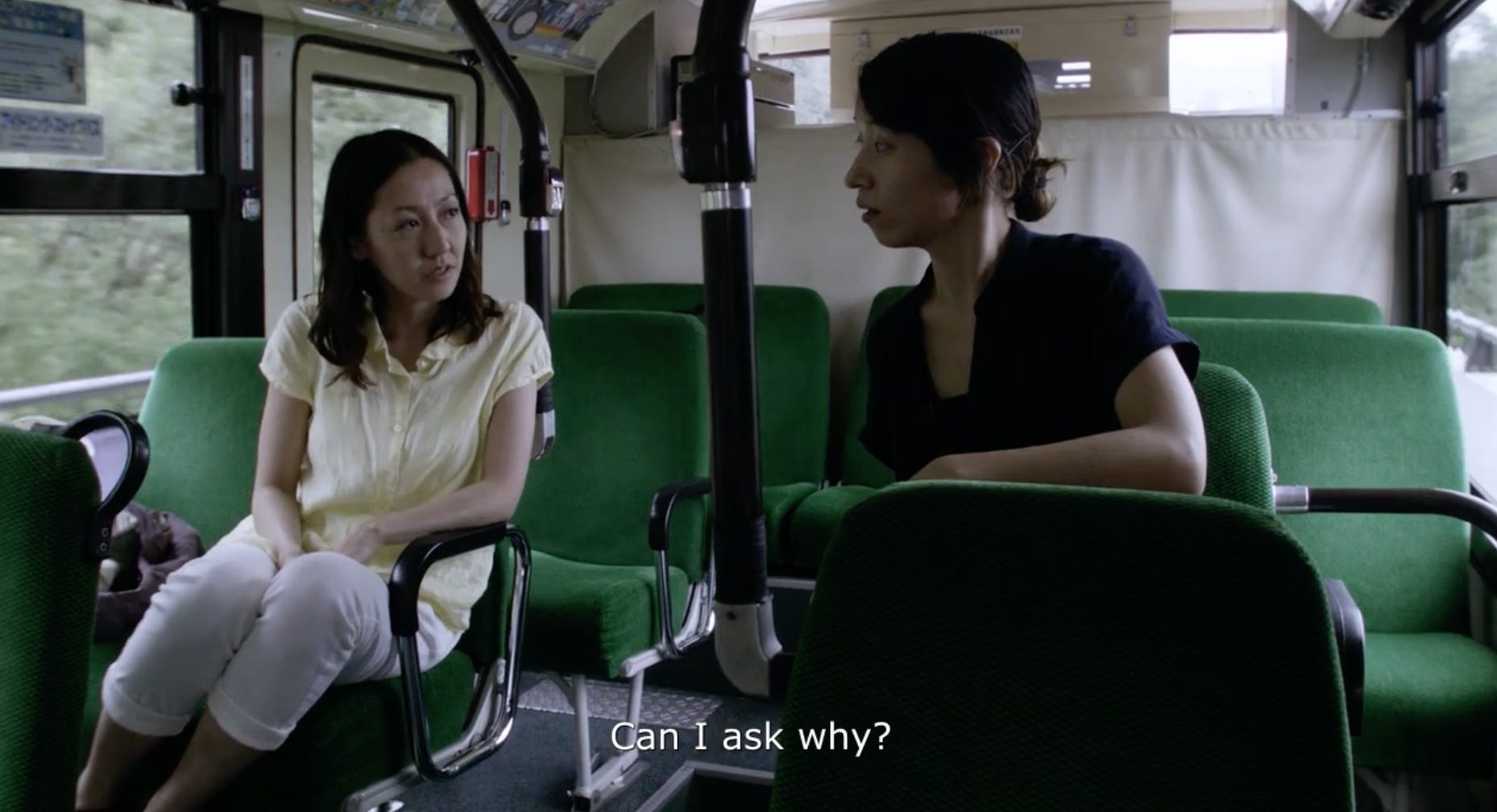
When Sakurako’s son finds out how his parents met, he tells Jun, “I heard I was born because of you.” He does not know how much this means to her – how much she has wanted to be a mother, how much of her marriage’s misery came from Kohei’s indifference to their fertility struggles.
This is Jun’s story: she is selfish in pursuit of her own happiness, but she also finds happiness in changing other people’s lives. Her own happiness is a source of constant struggle, embattled by a frigid husband, by divorce laws, by biology. But her legacy is the quality of seeing she brings to everyone she meets, whether it’s her best friend from childhood or a stranger she just met on the bus.
Recently, I met an older family friend I hadn’t seen in years. Halfway through the conversation, he started talking about astrology and why it explained some aspect of his personality. I started to tune out while nodding politely, disdainful of his beliefs but not wanting to start an argument. But then I thought, what would Jun do? She wouldn’t tune out of a conversation. She would be intensely fascinated by this lifelong software engineer, with an otherwise rational mindset, who believes in astrology.
So I channelled Jun. I asked him bluntly why he believed in astrology. Far from being put off by my question, he told me about the improbable series of fortunate events that had led to his current life, and how they made him more amenable to the idea that there are mysterious forces behind how lucky he has been. For a second, I glimpsed his childlike wonder about his own trajectory, the incredulity that enchanted him into thinking about the moons of Jupiter.
With Happy Hour, Ryusuke Hamaguchi taught me to treasure these glimpses. People are vast caverns of blood and light; the more we see of them, the more we realize we haven’t seen of them. I am addicted to spelunking into other people’s worlds; it is the most joyful Sisyphean task.
This comes from an essay featured in the Japanese film magazine Eureka, in a special feature dedicated to Hamaguchi that I pirated and machine translated.
This comes from an interview with the film critic Tetsuya Miura, in the same Eureka special feature mentioned above. Miura wrote an entire book about the movie, On Happy Hour, that I’ve been unable to find.